
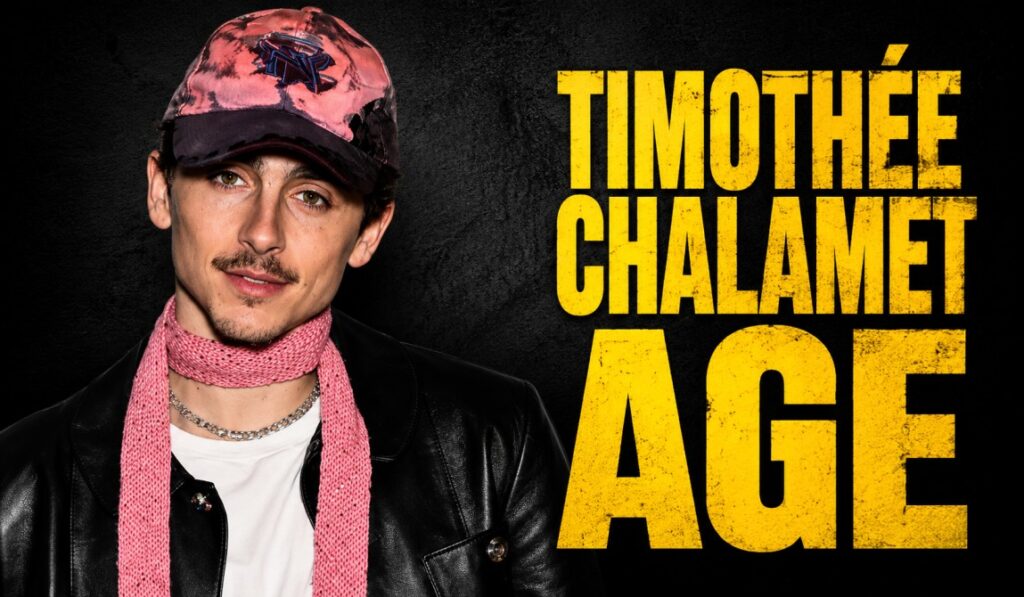
Timothée Chalamet is 30 years old in 2026, born on December 27, 1995, in Manhattan, New York City. In just over a decade of professional work, he built a filmography that most actors spend entire careers chasing — moving from emotionally raw indie dramas to franchise-defining science fiction epics and musical fantasy films without ever appearing to compromise on quality. People across the globe search “how old is Timothée Chalamet” with genuine curiosity, because the gap between his youthful face and the seriousness of his accomplishments remains one of modern Hollywood’s more disorienting paradoxes.
This guide walks through everything that matters about Timothée Chalamet’s age, early life, French-American heritage, education, television beginnings, Oscar-nominated breakthrough, blockbuster success, fashion influence and cultural staying power. Whether you first encountered him through Dune, discovered Call Me by Your Name late on a streaming platform, or watched him reinvent Willy Wonka for a new generation, what follows is a complete and factual account of who he is and how he got here.
Timothée Chalamet’s Exact Age
Timothée Chalamet was born on December 27, 1995, making him 30 years old in 2026. His birthplace was Manhattan’s Hell’s Kitchen neighbourhood, a part of New York historically shaped by artists, performers and working-class ambition — an environment that suited his temperament from the beginning.
The question of his age persists online because audiences consistently underestimate it. His lean build, expressive features and quietly restless energy read as younger than the number suggests. Viewers who first encountered him in Call Me by Your Name assumed they were watching a drama student in his teens, not an actor who had already accumulated several years of professional television credits.
His birthday sitting between Christmas and New Year is a detail fans tend to remember fondly. Online searches around his age spike every late December and again whenever a major project lands or an awards cycle begins. The consistency of that interest, year after year, points to something more durable than passing celebrity curiosity.
Bio Table
| Detail | Information |
| Full Name | Timothée Hal Chalamet |
| Date of Birth | December 27, 1995 |
| Age in 2026 | 30 years old |
| Birthplace | Manhattan, New York City, USA |
| Nationality | American, French |
| Languages Spoken | English, French (fluent) |
| Mother | Nicole Flender (Broadway dancer, real estate) |
| Father | Marc Chalamet (editor, journalist) |
| Sibling | Pauline Chalamet (older sister, actress) |
| School | Fiorello H. LaGuardia High School |
| University | Columbia University, then NYU Gallatin |
| Breakthrough Film | Call Me by Your Name (2017) |
| Oscar Nomination | Best Actor, 90th Academy Awards |
| Major Films | Call Me by Your Name, Dune, Wonka, Little Women, Beautiful Boy |
| Estimated Net Worth | $25 million |
| Fashion Affiliation | Multiple luxury houses |
Early Childhood
Timothée Chalamet spent his earliest years in Hell’s Kitchen, a Manhattan neighbourhood that has long attracted creative people priced out of more fashionable postcodes. Theatre, street energy and the particular density of New York cultural life surrounded him before he had any framework for what any of it meant.
His mother, Nicole Flender, brought a Broadway dancing background into a second career in real estate, which meant performance was never an abstract concept in the household — it was simply what one of his parents had done professionally. His father, Marc Chalamet, worked as an editor and journalist with genuine personal roots in France, and the family maintained real transatlantic connections rather than treating European heritage as a biographical detail to mention occasionally.
Summers in France were a consistent feature of his childhood, and he absorbed French as a spoken language through lived experience rather than classroom instruction. Moving between Manhattan’s relentless creative energy and the quieter pace of French provincial life gave him an unusually broad cultural frame of reference for someone his age. Teachers who knew him early on noted emotional attentiveness, fast humour and a willingness to commit fully to whatever creative task was in front of him.
Family Background
Artistic seriousness runs through the Chalamet family in a way that feels structural rather than coincidental. His mother’s firsthand experience of professional performance gave her an understanding of what training and dedication actually required. His father’s journalism background cultivated precision, narrative instinct and intellectual curiosity in both children.
His older sister, Pauline Chalamet, pursued acting independently and built her own distinct career in film and television. Two siblings choosing the same demanding profession from the same household is rarely accidental — it reflects an environment where storytelling was treated as worth taking seriously.
The French-American dual identity that became part of Timothée’s public image was lived rather than constructed. Growing up watching European cinema alongside Hollywood productions gave him critical awareness and aesthetic range that distinguished him from peers whose entire cinematic education occurred within the American studio tradition. French filmmaking’s emphasis on psychological realism and emotional restraint left visible marks on how he later approached character work.
Education and School Life
After MS 54 Booker T. Washington Middle School, Timothée Chalamet enrolled at Fiorello H. LaGuardia High School of Music and Art and Performing Arts — the New York institution that has produced working actors, musicians and dancers across several generations. Drama training there was rigorous and competitive, and he approached school productions with the same seriousness he would later bring to professional sets.
Outside formal drama classes he made comedic videos and sports-themed sketches, demonstrating that his instinct for performance extended beyond classical stage technique. These informal experiments with self-generated content showed creative range that purely academic training wouldn’t have revealed.
After graduating, he briefly attended Columbia University before transferring to NYU’s Gallatin School of Individualized Study, a programme designed for students whose intellectual interests don’t fit standard departmental boundaries. Acting commitments accelerated faster than formal study could accommodate, and he eventually stepped away from undergraduate education without completing a degree — though the intellectual environment clearly continued shaping how he talks about film and craft.
First Acting Roles
Timothée Chalamet’s early professional résumé followed the standard pattern for serious young actors building toward something larger: commercials first, then television guest appearances, then increasingly substantial recurring roles.
His appearance in the long-running procedural Law & Order gave him his first experience of a professional television production. A recurring role in Homeland, the political thriller, provided significantly more demanding material — scenes that required emotional complexity while holding their own against experienced adult cast members. Industry observers who caught his Homeland work noted something specific: a capacity for genuine on-screen vulnerability without any visible self-consciousness about displaying it. For a male actor of his age, that openness was unusual.
His 2014 supporting appearance in Christopher Nolan’s Interstellar placed him briefly inside an enormous mainstream production, though not yet in a way that announced a leading-man trajectory. He was learning how large-scale filmmaking operated from the inside, gathering experience that would matter when he found himself at the centre of similarly ambitious projects a few years later.
Breakthrough With Call Me by Your Name
The single most consequential event in Timothée Chalamet’s acting career was Luca Guadagnino’s Call Me by Your Name, released in 2017. The film cast him as Elio Perlman, a seventeen-year-old spending a summer in northern Italy navigating first love with sustained emotional transparency that most experienced performers would find challenging to sustain across a full feature.
He was approximately twenty years old during principal photography. His performance registered with psychological depth and physical specificity that left critics reaching for comparisons with actors decades older. Every scene required externalising interior states — longing, confusion, joy, grief — almost entirely through facial expression and physical presence, and he delivered with a precision that felt entirely uncontrived.
The film became a critical phenomenon and a cultural touchstone that introduced a new wave of younger audiences to thoughtful, character-centred cinema. Searches for “how old is Timothée Chalamet” began climbing during the film’s release cycle and never meaningfully dropped. His sudden international fame felt both entirely deserved and slightly overwhelming in its scale.
Oscar Recognition
The Academy Award nomination for Best Actor at the 90th Oscar ceremony confirmed formally what critics had established informally: Chalamet’s performance in Call Me by Your Name belonged in serious conversation with the year’s best screen acting. At twenty-two during the awards season, he became one of the youngest Best Actor nominees in the category’s modern history.
The nomination transformed his professional standing with near-immediate effect. Directors and producers who had noticed his talent began treating him as both an artistic collaborator and a commercially serious proposition — a combination genuinely rare at any age and almost unprecedented before twenty-five.
He didn’t win, but the nomination built something arguably more durable than a trophy: a reputation for serious craft that subsequent blockbuster successes never diluted. Audiences who first encountered him through the Academy coverage discovered Call Me by Your Name and followed his career from there, creating a fanbase with unusually wide demographic reach.
Rise to Global Fame
The months and years following the Oscar nomination saw Timothée Chalamet become one of the most discussed young actors on the planet. His visibility spread across film press, fashion media and social platforms simultaneously — a convergence that created a particular kind of modern celebrity in which cinephiles, fashion followers and internet communities arrived at overlapping enthusiasm through entirely separate routes.
His fame grew through work quality and thoughtful public presence rather than controversy or manufactured provocation. Interviews revealed intellectual seriousness, self-deprecating humour and genuine curiosity about filmmaking as craft rather than career strategy, qualities that resonated strongly with younger audiences who had grown instinctively suspicious of performed authenticity.
Luxury fashion houses recognised his cultural reach early, positioning him as someone who could carry editorial risk with apparent ease. His red-carpet appearances began generating their own news cycle independently of whatever project he was currently promoting, adding a consistent parallel visibility between film releases.
Major Film Roles
Timothée Chalamet’s post-breakthrough filmography demonstrated deliberate range. Greta Gerwig’s Lady Bird gave him a precisely drawn supporting role that introduced him to audiences who would become his most loyal long-term following. Beautiful Boy, a demanding drama about addiction and family collapse, required him to sustain physical and psychological deterioration across an extended performance opposite Steve Carell, earning further award recognition and confirming that Call Me by Your Name was not a one-off alignment of perfect circumstances.
Gerwig’s Little Women cast him as Laurie, one of American literature’s most recognisable secondary characters, within an ensemble including Florence Pugh, Saoirse Ronan and Meryl Streep. His relaxed period-appropriate naturalism and genuine chemistry with his co-stars made the adaptation commercially successful and introduced him to viewers who hadn’t previously sought out his earlier work.
Each role occupied a different emotional register, collectively building a filmography that supported claims of genuine versatility rather than skilled repetition of a single approach.
Dune Success
Denis Villeneuve’s Dune, released in 2021, marked Timothée Chalamet’s definitive arrival as a full-scale blockbuster leading actor. Paul Atreides, the messianic protagonist of Frank Herbert’s sprawling science fiction novel, demanded charisma operating at an entirely different frequency from the intimate psychological performances that had established his reputation — physical authority, the ability to anchor vast production design without being swallowed by it.
He was twenty-five at the time of release. His casting brought younger audiences into a franchise whose source material had previously skewed older, while his critical credibility ensured that Villeneuve’s artistic ambitions weren’t dismissed as merely commercial decoration.
Both Dune and its sequel performed strongly with audiences and reviewers alike, confirming that his transition from art-house favourite to bankable studio lead was complete. His name alone had become sufficient justification for major theatrical investment, a status very few actors reach at any age.
Playing Willy Wonka
Wonka, released during the 2023 holiday season, asked Chalamet to inhabit one of popular culture’s most over-familiar characters and make the performance feel fresh enough to justify its existence. Portraying a younger version of Roald Dahl’s eccentric chocolatier, he traced the origin story through musical sequences, physical comedy and emotional warmth that critics and audiences received enthusiastically.
At approximately twenty-seven during production, he brought unforced youthful energy to a role that might have calcified under the accumulated weight of predecessor performances. The commitment to musical elements — he sang and danced throughout — was genuine, and audiences responded to the charm and sweetness of his interpretation.
The film reached families and younger children who had no prior framework for his dramatic work, expanding his audience considerably and demonstrating a willingness to experiment with genre that characterises the most interesting long-term careers.
Fashion Influence
Timothée Chalamet’s impact on menswear culture is real and measurable. His red-carpet appearances consistently challenge conventional expectations of male celebrity dressing — bold colour choices, experimental silhouettes, unconventional fabrication — and he carries these choices with apparent ease that makes them feel like genuine expression rather than styled performance.
Luxury brands responded by involving him in campaigns and front-row placements, recognising that his endorsement carried genuine weight with younger consumers who had grown indifferent to traditional aspirational celebrity marketing. Fashion publications began covering his appearances with the seriousness usually reserved for professional models or long-established style figures.
The broader cultural significance was substantial. Male red-carpet dressing had been largely static for decades. Chalamet’s willingness to invite comment shifted the conversation and gave younger men cultural permission to engage with personal style as genuine creative expression rather than mere compliance with inherited convention.
Social Media Popularity
Timothée Chalamet maintains a deliberately controlled personal social media presence, yet his online cultural footprint is enormous. The apparent contradiction resolves when you recognise that contemporary celebrity fandom generates its own vast content ecosystem independently of what a subject chooses to post.
Fan communities produce edits, analysis threads, compilation videos and meme formats continuously, keeping him present across platforms regardless of his own posting frequency. This distributed fan-generated content maintains sustained online visibility without requiring personal oversharing — a balance many celebrities attempt and remarkably few achieve.
Search interest in his age, films and personal life spikes reliably during film releases, award ceremonies and viral moments. The consistency of that interest across multiple years indicates genuine sustained engagement rather than short-cycle hype that fades between projects.
Relationships and Dating Life
Timothée Chalamet’s personal relationships attract substantial public attention driven partly by his fame and partly by the natural curiosity surrounding a young celebrity who guards biographical details while remaining entirely public professionally.
He has been linked to several high-profile figures over the years, generating considerable social media discussion and entertainment press coverage. The contrast between his professional openness and personal reticence creates a productive kind of mystery — audiences feel they know him through his performances while genuine private details remain genuinely private.
His consistent practice of declining to discuss relationships at length in interviews has maintained that boundary without producing the resentful speculation that aggressive privacy protection sometimes generates. Fans generally respect the distinction, possibly because his film work provides enough genuine emotional access to satisfy the curiosity that drives celebrity interest in the first place.
Friendship Circles
The professional and social world Timothée Chalamet inhabits reflects his position at the intersection of serious filmmaking and mainstream cultural visibility. He maintains genuine relationships with directors, fellow actors and musicians whose work he actually admires, producing a professional network that reads as authentic affiliation rather than calculated positioning.
Co-stars consistently describe him as collaborative, thoroughly prepared and attentive to ensemble dynamics rather than narrowly focused on his own screen time. Directors who have worked with him speak about emotional intelligence and willingness to explore uncomfortable psychological territory without requiring elaborate protective conditions.
These relationships also provide audiences with informal glimpses of his personality in contexts that official interviews rarely allow, which contributes to the sense of knowing him that sustains long-term fan interest.
French Heritage
The French dimension of Timothée Chalamet’s identity is lived experience rather than biographical shorthand. His father’s roots created genuine cultural connection — regular childhood summers in France, natural language acquisition, deep absorption of European cinema traditions — rather than a heritage mentioned occasionally for international press appeal.
French audiences embraced him early, recognising in his acting style qualities their own cinema prizes: psychological realism, emotional honesty, the capacity for stillness and implication rather than demonstrative performance. His fluency allowed him to engage with French media in their own language, an unusual gesture that French cultural institutions consistently notice and reward.
The dual cultural grounding gave him an artistic frame of reference unavailable to American actors whose entire cinematic education occurred within the Hollywood tradition. European influences on his taste in directors, performance approaches and narrative preferences are consistently audible in how he discusses his work.
Acting Style
Critics writing seriously about Timothée Chalamet’s performances tend toward the same descriptors: emotional transparency, physical specificity, the ability to register complex interior states through minimal external means. These qualities belong to a recognisable tradition of screen naturalism, but his execution carries a personal signature that distinguishes his work from competent technique.
He builds character from the inside outward, establishing psychological reality before addressing surface presentation, which produces performances that feel inhabited rather than assembled. The result is an unusual intimacy — viewers feel they are observing something genuine rather than watching a skilled professional simulate authenticity.
As he has moved through his late twenties and into his thirties, the work has grown more technically assured without losing the quality of genuine discovery that made his earliest performances so striking. The combination of accumulated craft and persistent emotional openness is precisely what mature screen acting requires and rarely achieves.
Awards and Recognition
Timothée Chalamet’s awards record across his twenties was exceptional by any reasonable standard. Beyond the Academy Award nomination, he collected recognition from BAFTA, the Golden Globes, the Screen Actors Guild and numerous critics’ organisations, building a body of formal acknowledgment that positioned him clearly among the most respected performers of his generation.
The volume of nominations before his thirtieth birthday places him in uncommon company. Most actors who achieve comparable formal recognition do so after decades of steady accumulation. Achieving it within the first decade of a career, across genuinely different types of performance, suggests something beyond ordinary talent meeting favourable casting circumstances.
These awards also served a practical function, ensuring that every subsequent project arrived with critical attention already primed regardless of its commercial positioning.
Why Fans Ask His Age
The enduring search volume around Timothée Chalamet’s age reflects several converging factors rather than simple biographical curiosity.
His appearance consistently reads younger than his actual age, creating a persistent perceptual gap that people find genuinely interesting to interrogate. When audiences calculate that the twenty-year-old filming Call Me by Your Name is now thirty, the mental recalibration is real and slightly surprising.
His rapid professional ascent invites age-anchored thinking. People naturally want to understand the timeline of exceptional achievement. How old was he at the Oscar nomination? How old when Dune came out? These questions generate coherent answers that tell a compelling story.
Finally, contemporary celebrity culture is simply more age-conscious than previous generations. Comparative age discussions between actors, musicians and influencers are a standard feature of fan community interaction, and Chalamet occupies a prominent position in those ongoing conversations.
Comparison With Other Actors
Timothée Chalamet belongs to a cohort — alongside Zendaya, Florence Pugh and Saoirse Ronan — who achieved international prominence during the streaming-accelerated, social-media-amplified era of the mid-to-late 2010s. The defining characteristic of this group is global visibility achieved far more rapidly than previous generations managed, because digital platforms eliminated the geographic constraints that had previously limited an actor’s reach.
What distinguishes Chalamet within that cohort is the particular combination of art-house credibility and blockbuster commercial success. Very few performers his age have sustained serious critical respect while also anchoring major studio franchises — the gravitational pull of each category tends to erode the other. His trajectory also benefited from unusually sound project selection at an early stage, suggesting either exceptional industry instincts or excellent guidance, most likely both
Influence on Young Audiences
The influence Timothée Chalamet holds over younger audiences extends well beyond conventional celebrity fan culture. He became a genuine reference point for discussions about masculinity, emotional expression and personal style that had cultural substance rather than simply reflecting commercial positioning.
His film roles consistently explored vulnerability, identity confusion and emotional sensitivity in male protagonists — themes younger audiences find both personally resonant and historically underrepresented in mainstream cinema. Watching a major Hollywood actor inhabit those interior states without defensiveness or ironic distance gave many younger viewers a form of representational permission that registered beyond entertainment.
His fashion choices functioned similarly, demonstrating that male self-expression through clothing could be adventurous and deliberate without requiring justification. The downstream cultural effects are difficult to measure precisely but appear real and lasting.
Biggest Career Moments
The arc of Timothée Chalamet’s career has several genuinely defining turning points. Call Me by Your Name was the origin event, transforming a working television actor into an international film figure almost overnight. The Oscar nomination immediately following crystallised his critical standing permanently.
Beautiful Boy proved the breakthrough was repeatable rather than circumstantial. Little Women demonstrated commercial range. Dune completed the transition to full-scale blockbuster lead. Wonka demonstrated genre flexibility and willingness to risk something entirely outside his established register.
Each moment represented not merely a successful project but a meaningful expansion of what audiences and the industry understood him capable of achieving.
Life Beyond Hollywood
Timothée Chalamet’s interests outside acting are consistent with his public persona rather than manufactured to add biographical texture. He has discussed hip-hop music extensively and with genuine specificity, referencing particular artists and records rather than deploying music taste as casual image management. Basketball appears regularly in interviews as both entertainment and personal practice.
These interests provide genuine conversational substance, making him appear less entirely sealed inside a performance-adjacent identity than many comparably famous actors. The sense that he exists as a complete person beyond the work he promotes is part of what sustains durable audience interest across long gaps between releases.
He participates in film festivals, supports artistic communities and engages with broader cultural life in ways that reflect genuine curiosity rather than promotional obligation.
Media Attention
Media coverage of Timothée Chalamet shifted character substantially after the Oscar nomination. Film-critical attention expanded to encompass fashion media, entertainment journalism, lifestyle coverage and celebrity reporting of varying registers and seriousness.
His awards ceremony appearances became significant fashion events in their own right, generating post-event analysis and social media discussion that often exceeded the scale of the ceremony itself. Every element of public appearance became subject to interpretation and commentary.
Interviews suggest he finds the intensity of this attention occasionally uncomfortable, and his genuine preference for discussing craft over celebrity culture is consistently legible. Paradoxically, that mild awkwardness with pure celebrity machinery makes him more appealing to audiences who share his apparent ambivalence about the promotional complex surrounding modern filmmaking.
Public Image
Timothée Chalamet’s public image occupies an unusual position — simultaneously approachable and slightly opaque, famous and in some fundamental sense genuinely private. Audiences feel they know him through his performances while recognising that the biographical person remains substantially unknown.
He represents a departure from the conventional Hollywood leading-man archetype. The hyper-masculine, emotionally guarded template that dominated preceding decades simply doesn’t describe him, and he neither performs an alternative version of that template nor positions himself explicitly against it. He occupies different emotional and aesthetic territory as though it were entirely natural.
This combination of artistic seriousness, fashion adventurousness, emotional openness and biographical privacy created a public persona that appealed across demographic lines and proved remarkably durable across sustained public attention.
Timothée Chalamet in 2026
At thirty in 2026, Timothée Chalamet stands at what might honestly be described as the beginning of his mature career phase — a remarkable statement given what he has already accomplished. The first decade of professional life produced an Oscar nomination, two major film franchises, genuine fashion cultural impact and a global fanbase of unusual demographic breadth.
He continues choosing projects that balance commercial ambition with artistic seriousness, maintaining credibility that distinguishes his career from those of actors who retreated into comfortable commercial repetition after comparable early success.
Industry observers expect the roles available to him through his thirties to become progressively more psychologically demanding, moving toward complex and morally ambiguous characters that require the kind of audience trust his twenties built carefully and consistently.
Career Timeline
1995 — Born December 27 in Manhattan, New York City.
Early 2000s — Grows up in Hell’s Kitchen; develops early interests in performance, sport and storytelling.
2009–2012 — Appears in commercials and television including Law & Order and Homeland.
2014 — Supporting role in Christopher Nolan’s Interstellar.
2017 — Call Me by Your Name transforms his career internationally.
2018 — Beautiful Boy earns further critical recognition for dramatic range.
2019 — Little Women expands mainstream commercial reach.
2021 — Dune establishes him as a bankable blockbuster leading actor.
2023 — Wonka demonstrates musical range and attracts family audiences.
2026 — At thirty, remains one of global cinema’s most closely watched performers.
Practical Information and Planning
Timothée Chalamet films typically receive wide theatrical releases before moving to streaming platforms, following standard studio distribution patterns. Major productions tend to premiere during awards season windows or major holiday periods.
Public appearances occur at film premieres, international festivals including Venice and Cannes, fashion events and award ceremonies across New York, Los Angeles, Paris and London. Standard cinema tickets for his films range between £10 and £25. Festival passes vary from approximately £100 for general audience access to substantially more for industry and gala events.
His films are available across major streaming platforms, with regional licensing determining specific availability. Physical media releases follow theatrical runs and provide the most reliable long-term access independent of subscription platform changes.
Future Career Expectations
The professional trajectory Timothée Chalamet has established points toward expansion rather than consolidation. Industry observers note his interest in the full breadth of filmmaking — including narrative structure, direction and production — suggesting that acting may eventually share space with broader creative involvement in projects.
His commitment to working with directors of genuine artistic vision — Guadagnino, Villeneuve, Gerwig, Nolan — rather than defaulting toward commercial convenience has built a professional network that should sustain access to ambitious work through his thirties and well beyond.
The psychological complexity of characters available to him will naturally increase as audiences accept him in roles that couldn’t plausibly belong to someone younger. The emotional groundwork of his twenties positions him well for that transition.
Cultural Impact
Timothée Chalamet’s cultural impact operates across several distinct domains simultaneously. Within cinema, he helped demonstrate that emotionally centred, character-driven stories about young men could attract significant audiences during an era dominated by superhero spectacle, providing studios with evidence that alternatives to franchise product could perform commercially.
Within fashion, his willingness to wear experimental menswear on the world’s most visible stages shifted the acceptable vocabulary of male celebrity dressing and offered younger men broader creative permission.
Within internet culture, the fan communities surrounding his work helped define how younger audiences engage with actors in the social media era — through creative reinterpretation, collective analysis and genuine critical engagement with the work itself rather than simply the persona.
Why He Remains Popular
Timothée Chalamet’s sustained popularity has a straightforward explanation: he keeps producing genuinely interesting work. The audiences who discovered him through Call Me by Your Name have followed a career that consistently rewards their attention with performances that evolve rather than repeat.
His fashion presence maintains visibility between film projects. His thoughtful interview persona sustains the impression of a person worth paying attention to beyond whatever he happens to be promoting. His artistic ambition reassures critics that commercial success hasn’t diluted the qualities that made his early work exceptional.
The combination is self-reinforcing. Critical respect attracts ambitious directors. Ambitious directors produce work that sustains critical respect. Audiences who care about both the artistic and cultural dimensions of modern celebrity find all of it consistently worth following.
FAQs
How old is Timothée Chalamet in 2026?
He is 30 years old, born December 27, 1995, in Manhattan, New York City.
When is Timothée Chalamet’s birthday?
December 27 — placed between Christmas and New Year, which fans celebrate annually online.
Where was Timothée Chalamet born?
Manhattan, New York City, specifically the Hell’s Kitchen neighbourhood.
Is Timothée Chalamet French?
Yes — through his father he holds French-American heritage and speaks fluent French.
How old was Timothée Chalamet in Call Me by Your Name?
Around 20 during filming and 22 years old throughout the subsequent awards season.
What is Timothée Chalamet famous for?
Primarily his acting in Call Me by Your Name, Dune, Wonka and Little Women, plus his wide fashion influence.
How old was Timothée Chalamet in Dune?
He was 25 years old when the first Dune film released theatrically in 2021.
Final Thoughts
Timothée Chalamet is 30 years old in 2026, born December 27, 1995, in New York City. The question his age consistently prompts is less about the number itself and more about what he managed to accomplish within it — an Oscar nomination, two major film franchises, a measurable cultural footprint across cinema and fashion, and a body of dramatic work that has held serious critical attention from the very beginning.
His story is one of genuine early talent meeting sustained artistic ambition meeting an unusually clear sense of what kind of actor he wanted to become. The decade ahead will likely reveal dimensions of his capability that his twenties only partially exposed. At thirty, he remains one of the most closely watched, genuinely admired and persistently searched figures in global entertainment — and the curiosity surrounding him shows no meaningful sign of diminishing.

I’m John Ilam, a content writer on AgeBioHub, focused on creating biography-based articles. I write about public figures, their life stories, careers, and personal backgrounds in a clear and simple way.
I keep my content focused on biographies so readers can easily find the information they’re looking for without confusion. My goal is to make every article informative, structured, and easy to read.