
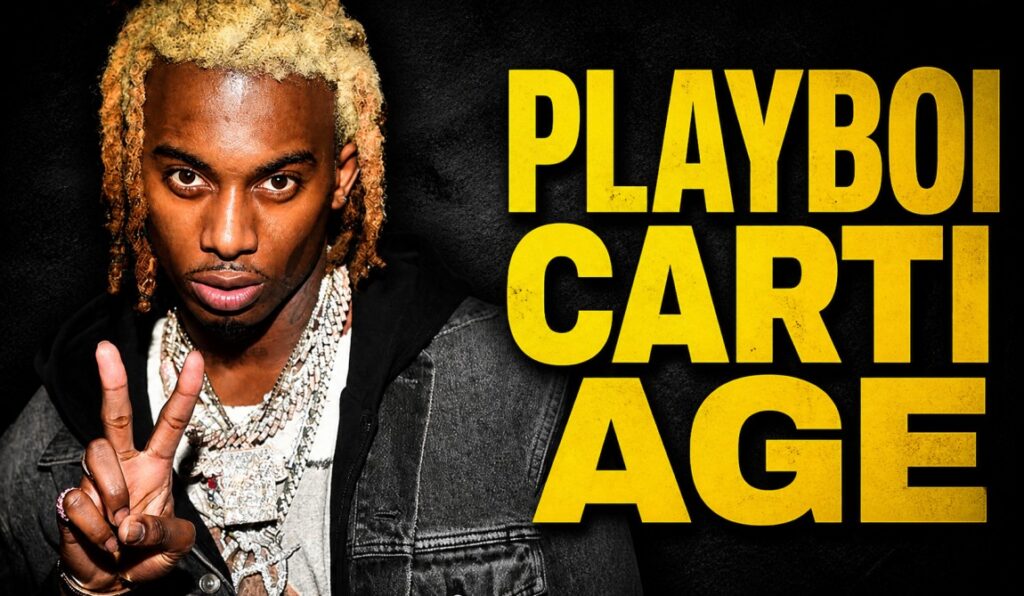
Playboi Carti age in 2026 is 30 years old — and that single fact continues to surprise fans who have watched this Atlanta-born rapper reshape modern hip-hop faster than almost anyone in his generation. Jordan Terrell Carter, born on September 13, 1995, in Riverdale, Georgia, has spent a full decade turning the rap world upside down through experimental trap music, boundary-pushing fashion, and a mysterious public persona that keeps millions of listeners permanently hooked.
What separates his story from the typical celebrity biography is the deliberate intention behind every move. From those early SoundCloud rap uploads as a teenager to founding the Opium record label and headlining global arena tours, Carti built an empire by consistently refusing to follow anyone else’s blueprint. His baby voice technique, gothic punk aesthetic, and ability to make silence feel like a cultural event have cemented him as far more than a recording artist — he is a living creative institution.
This complete guide covers Playboi Carti’s biography, exact age, zodiac sign, height, net worth, albums, relationship history, fashion influence, and everything in between. Whether you are a longtime member of the Opium fanbase or just discovering his music, every key detail about Jordan Carter rapper is right here.
Playboi Carti Age in 2026
Playboi Carti is currently 30 years old in 2026, having marked his birthday on September 13, 2025. That milestone carries genuine weight in hip-hop, where turning 30 traditionally signals either a creative slowdown or a full transformation into an industry elder. Carti is doing neither. Instead, he enters this decade with sharper artistic instincts, a thriving label ecosystem, and a fanbase that grows more devoted with every cryptic post and surprise release.
His thirties arrive loaded with momentum. The rage rap pioneer spent his twenties tearing down the conventions of mainstream hip-hop — rejecting traditional song structures, prioritizing sonic texture over verbal complexity, and building a visual universe that draws as heavily from 70s punk rock and gothic subculture as it does from Atlanta trap. That foundation, laid brick by brick through his early twenties, now supports one of the most distinctive brands in the entire music industry.
At 30, Carti balances youthful creative energy with executive-level authority. Through the Opium label, he mentors emerging artists like Ken Carson and Destroy Lonely, shaping the next wave of experimental rap while maintaining his own output. His age in 2026 represents something rare in this genre — a digital streaming era artist who achieved massive early success without burning out or selling out.
Playboi Carti Date of Birth and Zodiac Sign
Jordan Terrell Carter was born on September 13, 1995, placing him under the zodiac sign of Virgo. For anyone who follows astrology, that classification might initially seem counterintuitive. Virgos are methodical, detail-obsessed, and precision-driven — qualities that sit at an odd angle to Carti’s wild stage presence and deliberately chaotic public image. But look more carefully at how he actually operates, and the Virgo traits become unmistakable.
Every Playboi Carti album rollout is a study in calculated restraint. The cryptic social media posts, the deleted grids, the blurry teasers that arrive without warning — none of it is accidental. The vamp aesthetic he constructed for Whole Lotta Red was assembled with the kind of meticulous attention to detail that most artists apply to their lyrics. His Virgo nature likely explains his reclusive recording habits too: disappearing from public view for months, quietly building an entirely new creative world, then detonating it all at once.
Growing up as a mid-90s Atlanta native meant absorbing the golden era of Southern hip-hop in real time. Artists like Gucci Mane, Lil Wayne, and Young Jeezy provided the foundational grammar he would later systematically dismantle. His September birth date places him at the crossroads of summer’s end — fitting for an Atlanta rapper who consistently arrives just when the cultural moment needs resetting.
How Old Was Playboi Carti When He Became Famous
Carti was just 19 years old when he first generated serious industry buzz in 2015. Singles like “Broke Boi” and “Fetti” spread rapidly through SoundCloud rap communities, catching the attention of underground listeners who recognized something genuinely different in his minimalist delivery and bass-heavy production preferences. He was a teenager operating with a confidence that most veteran artists spend careers trying to develop.
The mainstream breakthrough arrived at 21, when his self-titled debut mixtape dropped in 2017 and “Magnolia” became an inescapable cultural moment. The track’s viral spread — fueled partly by its connection to the milly rock dance trend and Pi’erre Bourne’s instantly recognizable production — pushed it to number 29 on the Billboard Hot 100 and introduced Jordan Carter to an audience far beyond the underground scene that had been following him for years.
That early fame gave him something invaluable: time. Being famous at 21 meant he could experiment aggressively, absorb criticism, completely reinvent himself aesthetically, and still be younger than most debut artists by the time his sound fully matured. The SoundCloud era rapper who recorded “Broke Boi” and the rage rap architect behind Whole Lotta Red are almost unrecognizable as the same person — and that evolution happened entirely within his twenties.
Early Life and Childhood of Playboi Carti
Jordan Carter grew up in Riverdale, Georgia — a suburb positioned just south of Atlanta that carries the city’s musical energy without its full intensity. His childhood followed a relatively conventional suburban pattern, but the creative restlessness underneath it was apparent early. He enrolled at North Springs Charter High School in Sandy Springs, where basketball initially consumed most of his competitive energy. The sport taught him discipline and the hunger to outperform peers — qualities that transferred directly into how he approached music once that became his primary focus.
The turning point came gradually during his teenage years, when Atlanta’s trap music and crunk scene began pulling his attention more powerfully than any court or classroom could. The city in the early 2000s was a living curriculum in hip-hop innovation, and Carter was an attentive student. He began skipping school to spend time in local recording studios, absorbing production techniques and developing an ear for what made Atlanta’s sound so distinctively powerful.
His part-time job at H&M during high school planted the early seeds of what would become one of his most celebrated qualities. Handling garments, developing opinions about cut and silhouette, and observing how clothing communicated identity — all of that fed directly into the Playboi Carti fashion influence that would later see him sitting front row at Paris and Milan Fashion Weeks. The suburban kid folding shirts after school quietly became one of the most influential style figures in contemporary music.
Real Name and Background Information
Playboi Carti’s real name is Jordan Terrell Carter. Before the world knew that name, he recorded under the alias Sir Cartier — an earlier character that hinted at the same obsession with luxury and self-construction that defines his current persona. The shift from Sir Cartier to Playboi Carti was not simply a rebranding exercise; it represented a genuine philosophical evolution in how he understood his own artistic identity.
His Riverdale, Georgia background gave him a middle-ground perspective that proved creatively valuable. He was close enough to Atlanta’s street culture to absorb its authenticity, but far enough from its center to observe it with some detachment. That position — insider and outsider simultaneously — allowed him to bridge street-level trap music and high-fashion art in a way that neither a pure street artist nor a purely commercial one could have managed.
| Attribute | Detail |
| Full Name | Jordan Terrell Carter |
| Stage Name | Playboi Carti |
| Date of Birth | September 13, 1995 |
| Birthplace | Riverdale, Georgia, USA |
| Nationality | American |
| Zodiac Sign | Virgo |
| Former Stage Name | Sir Cartier |
| High School | North Springs Charter High School |
| Record Label | Opium / Interscope Records |
Playboi Carti Height, Weight, and Physical Appearance
Playboi Carti stands at 6 feet 1 inch tall (185 cm) and carries an estimated weight of approximately 165 pounds (75 kg). That lean, elongated frame is not incidental to his career — it is a genuine professional asset. High-fashion labels like Givenchy, Balenciaga, and Rick Owens build their silhouettes around bodies that can carry extreme proportions without losing visual coherence. Carti’s physique does exactly that, which is why his fashion collaborations feel organic rather than forced.
His physical appearance operates as a constantly shifting artistic statement. Tattoos cover substantial portions of his arms and chest, each one contributing to a visual narrative that extends his music into his body. His hair has moved through multiple eras — natural dreadlocks, bleached blonde phases, and most memorably, the vibrant red style that became inseparable from the Whole Lotta Red era and signaled to fans that an entirely new creative chapter was beginning.
The gothic punk aesthetic that defines his visual identity draws from leather jackets, spiked accessories, dark eye makeup, and oversized dramatic outerwear. These are not hip-hop wardrobe choices — they are deliberate departures from genre convention that signal his refusal to be contained by any single cultural category. That visual subversion is as intentional and carefully constructed as any lyric or beat he has ever released.
Playboi Carti Career Beginnings
Carti’s professional music journey began under the Sir Cartier alias around 2011, when he released his first project, Young Misfit — a raw, unpolished effort that sounded nothing like the artist he would eventually become. The lyrics were more conventional, the delivery more traditional, and the overall energy more cautious. It was the work of a teenager still figuring out what he wanted to say and, more importantly, how he wanted to say it.
The transformative chapter arrived when he relocated temporarily to New York City and connected with the A$AP Mob collective. His relationship with A$AP Rocky proved particularly significant — Rocky functioned as both mentor and door-opener, eventually helping Carti secure a deal with AWGE and Interscope Records. That industry foothold gave him the resources to develop his sound without the pressure of immediate commercial return.
Equally important was his immersion in the Awful Records collective, where he worked alongside artists like Father and Ethereal who shared his appetite for sonic experimentation. This underground period was where Carti’s minimalist rap philosophy crystallized: sparse production, bass-heavy arrangements, repetitive hooks that prioritized energy and emotion over narrative complexity. While other artists were adding more layers, he was deliberately stripping them away — and finding that the space created by that subtraction was exactly where his music came alive.
Breakthrough Success and Rise to Fame
The defining moment arrived in April 2017 with the release of his self-titled debut mixtape and the instant cultural phenomenon of “Magnolia.” Produced by Pi’erre Bourne, whose signature “Pi’erre, don’t fail me now” tag became one of hip-hop’s most recognizable producer callouts, the track moved with a momentum that caught even industry insiders off guard. Its connection to the milly rock dance trend amplified its spread across social media platforms, and it eventually peaked at number 29 on the Billboard Hot 100 — a mainstream arrival that nobody in the underground scene had fully anticipated.
Die Lit followed in 2018, and it locked in everything the mixtape had promised. Critics received it as one of the year’s most genuinely adventurous rap projects, praising its punk-influenced production and Carti’s commitment to prioritizing sonic atmosphere over conventional verse structures. Features from Nicki Minaj, Travis Scott, and Young Thug lent it commercial credibility without diluting its experimental edge. Die Lit was not trying to be a hit record — it was trying to be a statement, and it succeeded completely on those terms.
Playboi Carti Albums and Major Hits
Every Playboi Carti project functions less as a conventional album release and more as the public unveiling of an entirely new artistic identity. The extended gaps between releases are not delays — they are part of the architecture. By the time each project arrives, the anticipation has built to a level that guarantees every creative choice lands with maximum impact.
Playboi Carti (2017): The debut mixtape that introduced “Magnolia” and “wokeuplikethis*” to a global audience. Both tracks defined the SoundCloud rap era and remain among his most-streamed songs nearly a decade later — a testament to how fully realized that early creative vision actually was.
Die Lit (2018): His studio debut and the project most critics consider his most cohesive artistic statement. “Shoota” and “R.I.P.” became fan favorites, and the album’s punk trap production influenced a generation of younger artists who heard in it a roadmap for creative independence.
Whole Lotta Red (2020): Released on Christmas Day and initially divisive, this project has since been reappraised as one of the boldest creative swings in recent Atlanta hip-hop history. “Sky” accumulated billions of streams and became a genuine Gen Z anthem, while the vamp aesthetic it introduced reshaped underground rap’s visual and sonic identity.
I AM MUSIC (2025): The long-awaited fourth project that arrived after years of leaks, teasers, and fan speculation. Its release confirmed that Carti’s experimental rap evolution had no ceiling — he remained as committed to pushing into uncharted sonic territory as he had been on his first release.
Playboi Carti Net Worth in 2026
Playboi Carti’s net worth in 2026 is estimated between $25 million and $30 million — a figure that reflects the genuine financial complexity of his career rather than simple record sales arithmetic. His wealth flows from multiple directions simultaneously: music streaming royalties, global touring revenue, merchandise drops, and high-level fashion partnerships with brands that pay premium rates for authentic creative association rather than generic celebrity endorsement.
Touring has been especially lucrative. His arena-scale performances command production budgets and ticket prices that reflect his status as a genuine headline act rather than a supporting player. Merchandise releases tied to album cycles routinely sell out within hours, generating substantial revenue from a fanbase that treats every product drop as a collector’s event.
The most strategically significant component of his financial portfolio, however, is the Opium record label. By developing artists like Ken Carson, Destroy Lonely, and Homixide Gang from the ground up, Carti has constructed a revenue-generating ecosystem that operates independently of his own creative output. When Opium artists chart, tour, or land sync placements, that income flows back through the label structure he controls. At 30, that executive positioning distinguishes him from peers who are wealthy today but financially exposed tomorrow.
Playboi Carti Lifestyle and Luxury Assets
Carti’s lifestyle matches the persona his music constructs — extravagant in its details, carefully curated in its overall image, and deliberately mysterious in everything it withholds. He divides his time between Atlanta and Los Angeles, maintaining high-security private residences in both cities that serve double duty as personal sanctuaries and recording environments where his prolific creative sessions can unfold without outside interference.
His luxury car collection reflects the same aesthetic sensibility that governs his wardrobe choices — Lamborghinis, custom performance SUVs, and vehicles chosen as much for their visual alignment with his gothic rockstar image as for their engineering specifications. These are not random purchases; they are extensions of the carefully constructed world he inhabits and projects.
Fashion represents his most visible spending category. As a front-row regular at Paris and Milan Fashion Weeks, Carti receives and wears one-of-a-kind pieces from designers including Rick Owens and Raf Simons — garments created specifically for him that never reach retail. His relationship with these designers operates as genuine creative collaboration rather than paid celebrity placement, which is precisely why his fashion credibility remains intact in circles that are instinctively suspicious of rapper-brand associations.
Playboi Carti Relationship and Personal Life
Carti’s most publicly documented romantic relationship was with Australian rapper Iggy Azalea, which began in 2018. The two shared a home in Atlanta during the relationship’s peak and became one of hip-hop’s more scrutinized couples, with their personal dynamic generating consistent tabloid coverage. The relationship eventually dissolved, though it produced one of the most significant personal developments of Carti’s life — the birth of his son.
Beyond that high-profile chapter, Carti guards his personal life with genuine intensity. He does not participate in the celebrity interview circuit, does not feed the gossip ecosystem with deliberate leaks, and uses his social media presence to generate artistic mystique rather than personal transparency. Occasional reports of connections to figures within the modeling and fashion industries surface and fade without any confirmation or denial from Carti himself.
This deliberate privacy is not simply shyness — it is a considered strategic choice that reinforces the enigmatic quality central to his brand. An artist who explains everything demystifies himself. Carti has consistently understood that scarcity of personal information, like scarcity of musical content, amplifies the cultural value of whatever does emerge.
Playboi Carti Family and Children
Carti is the father of two children. His son, Onyx Kelly, was born in 2020 with Iggy Azalea. His daughter, Yves, arrived in 2024 with model Brandi Marion. Both children are maintained in careful privacy — Carti references fatherhood occasionally in rare public statements and interviews, but he has drawn a firm line between his public artistic identity and his responsibilities as a parent.
The contrast between his stage persona and his domestic reality is genuinely striking. The vampire-coded, deliberately alien figure who commands mosh pits and commands attention in the most theatrical terms imaginable is also raising two young children and navigating the practical, grounded demands that parenting places on any person regardless of fame. That human dimension is easy to overlook when the spectacle is as consuming as Carti’s tends to be.
At 30, balancing an active high-octane career with fatherhood represents the most private challenge in his otherwise very public life. He manages it almost entirely out of sight, which — given how deliberately he controls every other aspect of his public image — suggests it is also the part of his life he values protecting most.
Playboi Carti Fashion Style and Influence
Few living artists have reshaped mainstream fashion as directly as Playboi Carti has over the past several years. He is widely credited with bringing the “Opium aesthetic” into broad cultural circulation — a distinctive fusion of gothic sensibility, punk rebellion, luxury streetwear, and gender-fluid presentation that has migrated from his personal wardrobe into the wardrobes of teenagers in cities worldwide. All-black outfits, oversized leather silhouettes, platform footwear, spiked jewelry, and dramatic dark eye makeup are now common visual references in youth culture — and most of their current prevalence traces back to Carti wearing them first.
His collaboration history with the late Virgil Abloh was particularly consequential. As Abloh built Off-White into a global phenomenon and simultaneously helmed Louis Vuitton menswear, Carti’s consistent presence in his designs positioned both figures as serious creative forces operating at the intersection of streetwear and high fashion. That association gave Carti’s fashion credibility a legitimacy that pure celebrity placement could never have achieved.
His ongoing challenge to gender norms in hip-hop clothing is equally significant. By wearing pieces that explicitly reject traditional masculine dress codes in rap — and doing so without commentary or justification — he has quietly expanded what the genre’s visual culture permits. That normalization, achieved through action rather than advocacy, may be his most lasting cultural contribution outside the music itself.
Playboi Carti Social Media Presence
Carti’s social media strategy is the opposite of everything conventional digital marketing recommends — and it works more effectively than almost any orthodox approach in the industry. Rather than maintaining a consistent posting schedule or cultivating the parasocial intimacy that most modern artists pursue, he treats every online appearance as a discrete cultural event. A single blurry photograph posted without caption can generate millions of likes and hours of fan analysis. A mass deletion of his entire Instagram archive signals that a new era is beginning and sends the internet into genuine anticipation.
This scarcity model creates outsized engagement precisely because it trains his audience to treat every post as significant. When content is rare, attention is total. Carti has mastered this dynamic more completely than virtually any other artist currently operating at his level.
The broader Carti community — operating across Discord servers, Reddit threads, TikTok, and dedicated fan accounts — sustains his cultural presence through periods when he posts nothing at all. This fanbase generates memes, music edits, leak discussions, and lore-building content at a volume that keeps his name trending independently of any official output. The community has become, in effect, a self-powered media operation that amplifies his reach without requiring his direct participation.
Fun Facts About Playboi Carti
Behind the carefully constructed mystique, there are details about Jordan Carter that reveal something more personal about the man driving one of hip-hop’s most compelling creative stories.
Basketball Was the Original Dream: Before music claimed his full attention, Carti pursued basketball with genuine competitive seriousness. The work ethic and drive-to-outperform mentality that sports instilled in him translated directly into how relentlessly he approaches creative work.
The Baby Voice Was a Deliberate Invention: His signature high-pitched vocal delivery was not a natural speaking voice amplified — it was a conscious artistic decision inspired by wanting to sound simultaneously childlike and extraterrestrial, placing emotional atmosphere above verbal legibility.
The Vault Is Enormous: Carti records prolifically, with credible estimates suggesting thousands of unreleased tracks exist. The Carti leak culture is among the most active in contemporary hip-hop, with fans treating every surfaced snippet as an archaeological discovery.
Rick Owens Is a Genuine Obsession: His loyalty to the Rick Owens brand runs deeper than typical celebrity fashion association — he is specifically known for wearing the designer’s “Kiss” boots so consistently that the footwear became personally associated with him.
Retro Gaming Is a Real Passion: Away from the industry noise, Carti has expressed genuine enthusiasm for classic gaming consoles and retro game aesthetics — a surprisingly grounded hobby for an artist whose public image is built on otherworldly spectacle.
| Topic | Quick Detail |
| First Mixtape | Young Misfit (2011) |
| Former Alias | Sir Cartier |
| Label Founded | Opium Records |
| Signature Style | Gothic Punk Luxury |
| Biggest Streaming Hit | “Sky” — billions of plays |
| Fashion Week Presence | Paris and Milan, annually |
| Punk Inspiration | Sid Vicious and 70s rock culture |
| Signature Vocal Style | Baby voice / alien delivery |
FAQs
How old is Playboi Carti in 2026?
He is 30 years old in 2026, born September 13, 1995 — a milestone that marks a decade of reshaping modern hip-hop.
What is Playboi Carti’s real name?
His legal name is Jordan Terrell Carter, previously known by the stage alias Sir Cartier before adopting his current persona.
When was Playboi Carti born?
September 13, 1995, in Riverdale, Georgia — making him a Virgo whose meticulous precision hides behind a chaotic public image.
How tall is Playboi Carti?
He stands at 6 feet 1 inch (185 cm) with a lean build of approximately 165 pounds, making him a natural fit for high-fashion collaborations.
How many children does Playboi Carti have?
He has two children — son Onyx Kelly (born 2020, with Iggy Azalea) and daughter Yves (born 2024, with model Brandi Marion).
What is Playboi Carti’s net worth in 2026?
His net worth is estimated at $25 to $30 million, built through touring, music royalties, merchandise, and his Opium label business.
Who are the artists signed to Opium Records?
Ken Carson, Destroy Lonely, and Homixide Gang are among the key signees Carti has developed through his label.
Conclusion
Playboi Carti’s age in 2026 — 30 years old — is a useful entry point into a story that rewards far deeper examination. From the quiet suburbs of Riverdale, Georgia, Jordan Terrell Carter built something that most artists cannot even conceptualize: a complete artistic universe with its own aesthetic laws, its own community culture, its own fashion language, and its own musical grammar. He did it before turning 25, then spent the second half of his twenties refining and expanding it.
What makes his trajectory genuinely remarkable is not just the speed of the ascent but the consistency of the creative vision driving it. Every project, every silence, every cryptic post, every fashion appearance has been pointed in the same direction — toward something more extreme, more personal, and less compromised than what came before. The rage rap pioneer who shocked listeners with Whole Lotta Red is the same person who recorded “Broke Boi” in a teenager’s makeshift studio setup, just operating with vastly more resources and even sharper instincts.
At 30, with the Opium label thriving, his influence on Gen Z culture still expanding, and his own creative output showing no signs of softening, Playboi Carti is nowhere near the end of this story. He is, if anything, just reaching the chapter where the full scope of what he has built becomes truly visible. Whatever arrives next will be unexpected — and that, more than any specific achievement, is the most reliable promise his career has ever made.

I’m Rainlord, the creator of AgeBioHub. I focus only on writing age-based articles, answering simple questions like how old a person is.
Instead of covering multiple topics, I stay dedicated to this niche to keep my content clear, consistent, and useful. My goal is to provide quick and accurate age information in a way that’s easy for anyone to understand.