
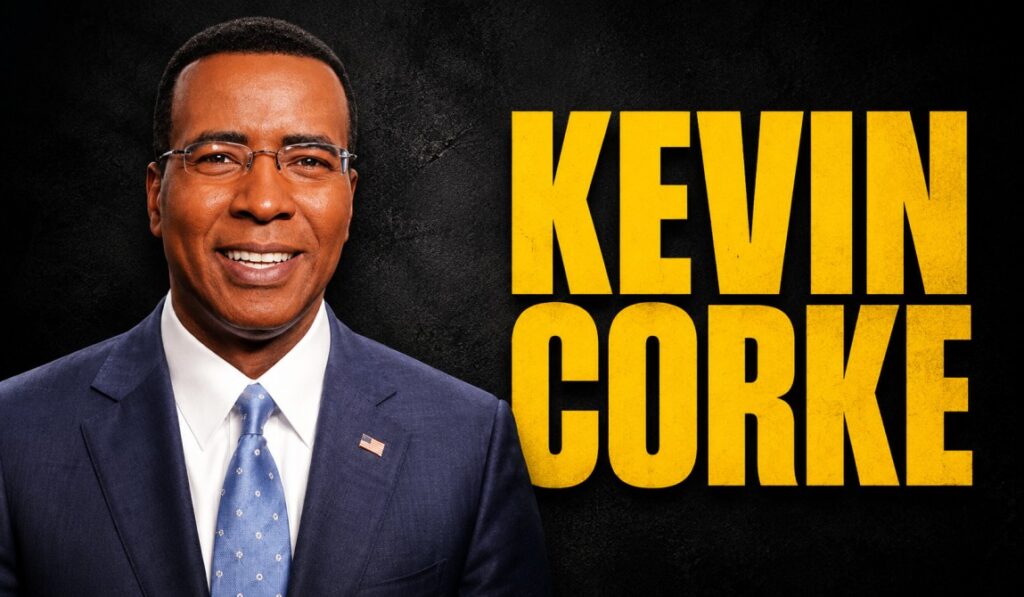
Kevin Corke spouse — this is one of the most searched phrases connected to the name of a seasoned Fox News White House Correspondent whose on-screen presence has defined political reporting for over two decades. Kevin Corke, currently 52 years old, has built an impressive journalism career covering presidential administrations, White House briefings, and high-stakes national affairs. Yet despite his daily visibility in front of millions, the question of who shares his personal life remains genuinely unanswered.
The name Rebecca Ramanda surfaces repeatedly across celebrity blogs and lifestyle forums as his rumored wife. She is described as a strategic business consultant based in Washington D.C., educated, professionally accomplished, and entirely removed from the public eye. Whether that description reflects reality or represents another layer of digital speculation is exactly what this article examines — carefully, honestly, and without repeating unverified claims as settled truth.
| Bio Table | Details |
| Full Name | Kevin Corke |
| Age | 52 years old (reported) |
| Profession | Broadcast Journalist, Fox News White House Correspondent |
| Nationality | American |
| Base Location | Washington, D.C. |
| Rumored Spouse | Rebecca Ramanda |
| Spouse’s Profession | Strategic Consultant (reported) |
| Spouse’s Education | MBA, Organizational Development (reported) |
| Children | Two (reported, unverified) |
| Marital Status | Unconfirmed publicly |
Early Life and Background of Rebecca Ramanda
Rebecca Ramanda’s story, as pieced together from widely circulated online profiles, traces back to a Midwest upbringing shaped by strong values around education, civic duty, and personal discipline. From an early age she is described as academically driven — the kind of student who approached challenges with both curiosity and structure. That intellectual foundation reportedly carried her through a demanding higher education path that would later define her professional identity.
According to sources that have covered this narrative, she earned a Bachelor’s degree in Business Administration and went on to complete an MBA with a concentration in Organizational Development — graduating with distinction. These credentials placed her firmly in the world of corporate strategy and organizational consulting, where analytical thinking and calm decision-making under pressure are non-negotiable professional requirements.
Her reported expertise spans regulatory compliance consulting, crisis management, internal and external communications strategy, and strategic planning for mid-sized companies and nonprofit organizations. For someone operating in Washington D.C.’s high-stakes environment, that skill set carries real weight — both professionally and personally.
What stands out most about Rebecca’s background is not what has been shared, but what hasn’t. Unlike many professional women in Washington DC who build visible public profiles alongside their careers, Rebecca has maintained a remarkably low digital footprint. No confirmed LinkedIn profile, no traceable social media presence, and no interview on record. Whether that reflects a deliberate personal privacy strategy or raises questions about the accuracy of her reported details depends entirely on how much trust one places in unverified online sourcing.
Marriage Rumors and Media Speculation
The Kevin Corke spouse narrative is a textbook illustration of how unverified marriage claims travel through the internet and eventually settle into perceived truth. It began, as these stories often do, with a single claim on a small celebrity profile site. That claim was picked up, lightly reworded, and republished — then republished again — until the sheer volume of repetition created the impression of consensus.
Today, multiple platforms identify Rebecca Ramanda Corke as Kevin’s wife. Some go further, describing the couple’s household routines, parenting philosophy, and even a reported vacation home in Colorado. Yet not one of these accounts references a verifiable source. There is no marriage certificate, no public statement from Kevin himself, no photograph from a ceremony, and no corroborating quote from anyone with firsthand knowledge.
What deepens the complexity is a reported episode from 2024, in which social media threads claimed Kevin had directly denied being married. Those threads, too, were unverified. So the public record now contains both an unconfirmed claim that he is married and an unconfirmed claim that he denied it — neither of which moves the needle toward actual clarity.
This cycle of claim and counter-claim is not accidental. It thrives specifically because Kevin refuses to engage with it. His silence, while entirely reasonable from a personal boundary standpoint, leaves a vacuum that online rumor cycles are exceptionally well-equipped to fill.
Kevin Corke’s Private Life vs. Public Persona
The contrast at the heart of Kevin Corke’s public identity is striking. On screen, he is authoritative, composed, and perpetually present — a journalist who has stood outside the West Wing through multiple administrations and delivered breaking political news with steady professionalism. In his personal life, he is the closest thing to invisible that a nationally recognized face can be.
His professional record speaks clearly. Kevin covered the Obama White House, reported across international bureaus including postings in Africa, and established himself as one of the more reliable voices in national political affairs coverage. His ability to contextualize policy shifts, translate complex governance decisions for general audiences, and maintain composure during high-stakes news events has earned him genuine respect within the industry.
His personal life, by contrast, is a deliberately blank page. He does not post images of a partner. He does not reference a spouse or children in interviews. He does not let the professional and personal spheres overlap in the way that social media has normalized for so many public figures in the current media climate.
That disciplined boundary raises an honest question: for a man whose entire career is built on extracting information and presenting truth, is the choice to withhold personal truth a contradiction — or simply the most logical application of what he knows about how public narratives are built and misused?
The Role of Privacy in Modern Journalism
The discussion around the Kevin Corke spouse story opens a genuinely important conversation about privacy rights for public figures — particularly journalists, whose professional function involves pursuing transparency in others while navigating intense scrutiny themselves.
There is a real irony embedded in how audiences relate to reporters. The same public that expects journalists to hold governments accountable and demand honest answers from powerful institutions often feels entitled to the same level of access into those journalists’ personal lives. Kevin Corke’s approach pushes back against that expectation quietly but firmly.
As a White House correspondent who has spent decades covering powerful people and institutions, he understands better than most how quickly a fragment of personal information can be shaped into a narrative. His decision to offer as few fragments as possible is not evasiveness — it is informed self-protection rooted in professional experience.
Rebecca Ramanda, whether or not she is who online profiles claim her to be, appears to operate from the same philosophy. She has not leveraged her rumored connection to a well-known journalist for professional visibility. She has not given interviews. In Washington D.C., where proximity to power is frequently converted into personal brand currency, that kind of restraint is unusual enough to be noteworthy.
There is also a mental health and professional longevity dimension here. Journalists covering federal politics and national governance operate under sustained psychological pressure — tight deadlines, public hostility, editorial scrutiny, and an increasingly polarized audience environment. The ability to return home to a life that exists entirely outside the news cycle is not a luxury — for many in the profession, it is what makes long-term sustainability possible.
Professional Partnership and Shared Success
The portrait that has emerged online — verified or not — depicts Kevin Corke and Rebecca Ramanda as a complementary professional pairing. His world is reactive, deadline-driven, and relentlessly public. Her reported world — organizational development consulting, strategic planning, crisis communication — operates on longer timelines, behind closed boardroom doors, with a premium on discretion.
If the relationship exists as described, the professional synergy would be natural and mutually reinforcing. A consultant specializing in crisis management and regulatory compliance would have an intuitive understanding of the pressures facing a journalist who covers government scandals, policy failures, and political upheaval. She would recognize the emotional weight of high-stakes reporting in ways that someone outside demanding professional environments simply could not.
Conversely, a journalist embedded in Washington’s political infrastructure would bring a sharp understanding of institutional dynamics — how power moves, how public perception shifts, how narratives are manufactured — that could meaningfully sharpen a consultant’s strategic thinking and client advisory work.
Washington D.C. has long been home to this kind of power couple dynamic: policy analysts married to communications directors, lobbyists partnered with academics, strategists alongside reporters. The city selects, to some degree, for people who thrive on complexity and find equilibrium not through similarity but through deliberate professional contrast.
Whether Kevin and Rebecca genuinely represent this archetype or whether the internet has simply projected it onto them, the model they are said to embody reflects something true about how high-functioning professionals sustain demanding careers — through partnership built on mutual respect, honest exchange, and shared intellectual curiosity.
Social Media Reactions and Public Perception
The online conversation surrounding Kevin Corke’s personal life offers a revealing window into how digital audiences construct and consume celebrity narratives in the absence of confirmed information.
Threads on X (formerly Twitter), Reddit, and entertainment blog comment sections follow a recognizable pattern: an unverified claim appears, gets amplified by engagement, is partially challenged, and then resurfaces again — usually slightly modified — on a new platform. The emotional range of participants is wide. Some users argue firmly for Kevin’s right to personal privacy. Others frame his silence as suspicious, reading deliberate withholding where there may simply be a private man living a private life.
A particular point of friction in these discussions is Rebecca Ramanda’s near-total digital absence. In an era when even genuinely private individuals tend to leave some traceable footprint — a professional directory listing, a tagged photograph from a community event, a mention in a corporate bio — the complete absence of verifiable information about her has fueled two opposing camps: those who accept her privacy as genuine and those who question whether her profile, as described online, reflects a real person at all.
This tension between public curiosity and personal boundary is not unique to Kevin Corke. It plays out constantly across the intersection of media, celebrity culture, and digital information. What makes this particular case instructive is the clarity with which it illustrates the process: when a public figure declines to fill a silence, the internet will fill it for them — and the filling is rarely more accurate than the silence it replaces.
Why the Kevin Corke Spouse Story Matters
At its core, the sustained interest in the Kevin Corke spouse narrative is not really about Kevin Corke or Rebecca Ramanda as individuals. It is about the mechanics of modern information ecosystems and the specific conditions under which unverified claims acquire the texture of established fact.
When ten websites independently state that Rebecca Ramanda is Kevin Corke’s wife, a reader encountering the eleventh experiences something that feels like verified consensus. The brain treats repetition as a reliability signal — a well-documented cognitive tendency that the digital media environment exploits constantly, usually without deliberate intent. Writers cite other writers, editors assume prior verification has occurred, and a claim that began without a single credible source gradually accumulates the appearance of one.
This story matters as a media literacy lesson — a concrete, accessible example of why the volume of information about a subject does not equal the quality of that information. The fact that it involves a journalist is not incidental. It is perhaps the most pointed possible illustration of the gap between what we expect from media professionals and how media itself actually functions in the age of content saturation.
It also raises genuine ethical questions about celebrity and lifestyle journalism. Is republishing unconfirmed personal details about a public figure defensible simply because others have done so first? At what point does audience curiosity transition from legitimate public interest into the spread of digital misinformation? These are not abstract questions. They have tangible consequences for real people — including anyone bearing the name Rebecca Ramanda who may find their identity, real or partially constructed, circulating without consent across hundreds of websites.
FAQs
Who is Rebecca Ramanda?
She is widely named online as Kevin Corke’s wife, but no verified public record or confirmed statement establishes her identity or connection to him.
Is Kevin Corke currently married?
Kevin Corke has never publicly confirmed a marriage; unverified 2024 social media posts even suggested he denied it.
Why does Kevin Corke keep his personal life so private?
As a Fox News White House correspondent covering sensitive federal politics, separating his professional visibility from his home life appears to be a deliberate, informed choice.
What is Rebecca Ramanda’s professional background?
She is reported to be a strategic consultant specializing in organizational development, crisis management, regulatory compliance, and corporate communications.
Are there verified photos of Kevin Corke and Rebecca Ramanda together?
No confirmed, credibly sourced photographs of the two together have appeared in any reputable media outlet.
How did the Kevin Corke spouse story gain so much traction online?
It spread through repetition without verification — one unconfirmed claim copied across lifestyle blogs until volume created the illusion of consensus.
Does Rebecca Ramanda maintain any public social media presence?
No verifiable social media accounts connected to Rebecca Ramanda have been identified, deepening both public curiosity and legitimate skepticism.
Conclusion
The story of Kevin Corke and Rebecca Ramanda runs along two parallel tracks that rarely intersect in the public record. One track belongs to a respected broadcast journalist — 52 years old, professionally decorated, and deliberate in every public word he speaks. The other belongs to a figure assembled largely from unverified online sourcing: a strategic consultant from the Midwest, educated, capable, and conspicuously absent from every platform where her existence might otherwise be confirmed.
What the public record does offer is this: Kevin Corke has earned his privacy, and he exercises it with the same intentionality that defines his on-air work. Whether Rebecca Ramanda stands beside him in that private life, or whether the internet has constructed a partner for him from fragments and assumptions, remains an open and genuinely unanswered question.
What the story leaves behind, more valuably than any confirmed personal detail, is a clear reminder about responsible information consumption. Not every silence is a secret. Not every repeated claim is a verified fact. And sometimes, the most honest thing that can be written about a person is simply: we do not know — and that deserves to be stated plainly, without apology.

I’m John Ilam, a content writer on AgeBioHub, focused on creating biography-based articles. I write about public figures, their life stories, careers, and personal backgrounds in a clear and simple way.
I keep my content focused on biographies so readers can easily find the information they’re looking for without confusion. My goal is to make every article informative, structured, and easy to read.