
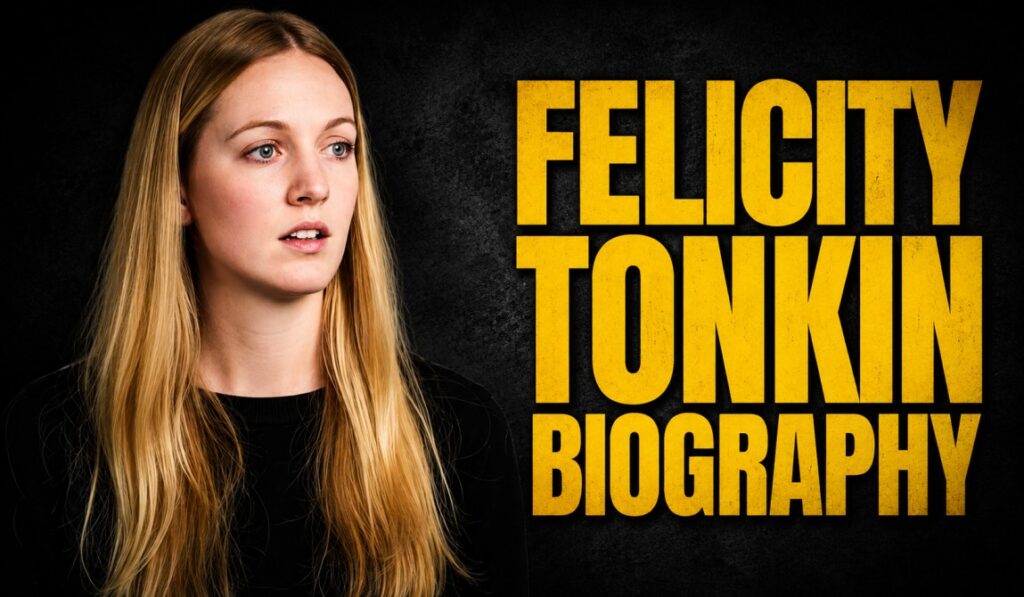
Felicity Tonkin is one of the most quietly compelling figures connected to the British royal family — not because she sought attention, but precisely because she never did. Born in 1985 in New Zealand, she is the biological daughter of Mark Phillips, the celebrated Olympic equestrian and former husband of Princess Anne, and Heather Tonkin, a New Zealand art teacher. For years, her very existence remained a carefully guarded secret, placing her among the most talked-about yet least visible figures in modern royal history.
Her story is not one of tiaras or televised ceremonies. It is a quieter, more human narrative — shaped by a paternity scandal that shook royal circles, a childhood built on deliberate distance from public life, and an adult life constructed entirely on her own terms. While her half-siblings Zara Tindall and Peter Phillips grew up as recognised faces of the royal establishment, Felicity chose horses, veterinary medicine, and a private family life over headlines. This biography explores who she truly is, where she came from, and why her choices matter.
| Detail | Information |
| Full Name | Felicity Tonkin |
| Date of Birth | 1985 |
| Place of Birth | New Zealand |
| Father | Mark Phillips |
| Mother | Heather Tonkin |
| Half-Siblings | Zara Tindall, Peter Phillips |
| Education | Massey University, New Zealand |
| Profession | Equine Veterinarian |
| Spouse | Tristan Wade (married 2015) |
| Children | James Wade (born 2017) |
| Nationality | New Zealander |
Early Life: A Hidden Beginning
Felicity Tonkin’s early life began in circumstances that were, by any measure, extraordinary. Her mother Heather Tonkin, an art teacher by profession, had a brief encounter with Mark Phillips during an equestrian clinic he conducted in Auckland, New Zealand. The relationship was fleeting, but it resulted in a pregnancy that Heather chose to handle quietly, away from the media storm that any public claim against a man married to Princess Anne would inevitably have triggered.
Heather raised Felicity largely as a single mother, providing a stable and grounded home environment. To protect her young daughter from a truth too complex for a child to carry, Heather told Felicity that her father had died. It was a decision born of maternal instinct rather than deception — a way of shielding a little girl from questions she was not yet equipped to answer.
The carefully maintained story began to unravel when Felicity was around eight years old. A routine school project on family history prompted the kind of digging that children do innocently and adults often dread. Inconsistencies surfaced. Questions multiplied. The truth — that her father was not dead but was in fact a prominent figure in British equestrian circles with deep royal connections — emerged gradually and with considerable emotional weight.
The Role of Heather Tonkin in Felicity’s Upbringing
Heather Tonkin is far more than a minor character in this story. As the primary caregiver and sole architect of Felicity’s childhood, she made a series of deliberate choices that shaped everything that followed. She did not approach tabloids. She did not seek to monetise her connection to royalty. She did not push her daughter into the public eye. Instead, she built a life of genuine normalcy — one that gave Felicity the emotional foundation to navigate her unusual circumstances with composure and dignity.
Her restraint was remarkable given the financial pressures a single mother might face and the media appetite for exactly this kind of story. That Felicity grew up grounded, professionally ambitious, and emotionally stable is, in large part, a tribute to Heather’s parenting.
The Scandal: Paternity Revealed
The 1991 paternity confirmation was the moment Felicity’s story briefly and explosively entered public consciousness. Heather Tonkin pursued legal recognition of her daughter’s parentage, leading to a court-ordered DNA test that confirmed Mark Phillips as Felicity’s biological father. The timing landed like a thunderbolt.
The early 1990s were already a period of acute turbulence for the British royal family. Senior royal marriages were breaking down publicly, media scrutiny was intensifying, and the institution’s reputation was under sustained pressure. The revelation that Mark Phillips had fathered a child outside his marriage to Princess Anne added another layer of scandal to an already fractured picture. The couple had separated in 1989; their divorce was finalised in 1992, with the paternity story contributing to the atmosphere of collapse surrounding that period.
British tabloids immediately seized on Felicity’s existence, applying the reductive label of “secret love child” and mining every available detail. Yet Felicity herself — still a child in New Zealand — remained entirely removed from the frenzy. While her name circulated in newsrooms, her actual life continued undisturbed, protected by geography and her mother’s resolve.
Mark Phillips’ Response to the Paternity Confirmation
Mark Phillips’ reaction to the confirmed DNA results was conspicuous in its restraint. He neither publicly denied the findings nor made any visible move to embrace fatherhood. No statement of acknowledgment was issued. No plans to be present in Felicity’s life were announced. Financial arrangements were reportedly settled privately, but any emotional or relational dimension of the father-daughter dynamic appeared absent from the outset.
This distance between a confirmed biological father and his daughter is one of the most quietly painful threads running through Felicity’s story. For a child who had been told her father was dead, discovering that he was alive — and then finding he had no apparent interest in a relationship — required a particular kind of emotional processing. That Felicity appears to have managed this with grace rather than bitterness is a reflection of the resilience that defines her character.
Growing Up Away from the Spotlight
Felicity’s New Zealand childhood unfolded at a reassuring distance from the world that might otherwise have claimed her. She attended local schools, formed friendships based on common ground rather than family name, and developed interests that were genuinely her own. The gap between her daily life and the royal drama attached to her parentage was, practically speaking, vast.
New Zealand’s geographic remove from Britain provided a natural buffer. Even when UK press occasionally revisited her story, the noise rarely penetrated the quiet of her everyday existence. She was not trailed by photographers. She was not treated as a curiosity by classmates who largely did not know the full picture of her background. She was, in the most important sense, simply a young woman growing up.
How Her Upbringing Differed from Her Royal Half-Siblings
The divergence between Felicity’s upbringing and that of Zara Tindall and Peter Phillips is sharp and telling. Zara and Peter were raised as grandchildren of Queen Elizabeth II, their lives structured around royal events, expectations, and the ever-present awareness of public roles. Press interest in them was continuous from childhood. Their identities were, to a significant degree, publicly constructed before they were old enough to construct them privately.
Felicity experienced none of this. Her identity formed in private. Her milestones belonged to her. The absence of external expectation, while carrying its own complications given what she knew of her parentage, ultimately gave her something her half-siblings never fully had — the freedom to become whoever she chose to be, entirely without the weight of a public narrative.
Career: A Life of Passion for Horses
The most striking thread connecting Felicity Tonkin to Mark Phillips beyond blood is their shared devotion to horses. Phillips built an international reputation as one of Britain’s foremost equestrians, competing at Olympic level and coaching the sport’s elite. Whether the influence is genetic, circumstantial, or simply a convergence of independent passions, Felicity developed an equally profound relationship with horses — one that became the cornerstone of her professional life.
She pursued veterinary science at Massey University, a New Zealand institution with particular strength in equine medicine and one of the most respected veterinary schools in the Southern Hemisphere. The choice was deliberate and demanding — veterinary science is among the most academically rigorous disciplines, requiring sustained excellence across biological sciences, clinical practice, and animal behaviour.
Specialisation in Equine Veterinary Medicine
Following her graduation, Felicity chose to focus on equine veterinary medicine — a specialist branch concerned with the diagnosis, treatment, and ongoing care of horses across performance, breeding, and working contexts. It is exacting, physically demanding work that places a practitioner at the intersection of sport, science, and animal welfare.
Her professional standing within New Zealand’s equestrian community has been built on genuine expertise rather than famous connections. She works alongside professional riders, supports the care of competition horses, and brings clinical knowledge to a world she is personally invested in. The career is a clean expression of who she is: skilled, purposeful, and entirely self-made.
A Career That Reflects Her Values
There is something quietly powerful about the fact that Felicity Tonkin chose a career defined by rigour and compassion rather than one that traded on her extraordinary family circumstances. Royal connections, strategically deployed, can open considerable doors. She closed those doors deliberately and opened others through years of academic and professional work. The result is a professional identity that belongs entirely to her — untouched by the Phillips name, the royal association, or the scandal that once attached itself to her birth.
Personal Life: Marriage and Family
In 2015, Felicity married Tristan Wade, a professional polo player whose own deep roots in the equestrian world made the partnership an organic one. Both share a lifestyle anchored in horses, both appear to hold privacy as a core value, and both have maintained a public profile so low as to be essentially invisible to anyone not already familiar with their equestrian circles.
The wedding itself was a private event — no press coverage, no celebrity adjacency, no indication that either party had any interest in the kind of attention Felicity’s background might have generated. In 2017, their son James Wade was born, and the family settled into the same quiet rhythm they have maintained ever since.
Life in New Zealand as a Deliberate Choice
The decision to remain rooted in New Zealand rather than explore the UK connections her parentage might justify is itself a statement. It reflects the same values Felicity has demonstrated throughout her life — a preference for the genuine over the glamorous, the earned over the inherited, the private over the performed.
Within equestrian and veterinary circles, the family is known as grounded and community-minded. They participate in local and national events without seeking broader attention. Their lives are embedded in a community built around shared professional passion rather than social performance — a model entirely consistent with everything else Felicity has chosen.
Relationship with Her Half-Siblings and Father
The emotional complexity at the heart of Felicity Tonkin’s story centres on the relationships she has never had. Zara Tindall — decorated equestrian, beloved public figure, married to rugby icon Mike Tindall — and Peter Phillips are her half-siblings by blood. They share a father. They share a world, in the sense that all three operate within equestrian circles. And yet there is, by all available evidence, no meaningful connection between them.
No documented meetings exist. No public acknowledgment of the relationship has come from either side. No joint appearances at equestrian events — despite the fact that all three have professional reasons to occupy similar spaces — have been recorded. The absence may reflect deliberate distance, mutual indifference, or simply the practical reality of lives lived in different countries with no organic point of contact. What it certainly reflects is that blood alone does not build family.
The Absent Father: Mark Phillips
Mark Phillips’ absence from Felicity’s life is a thread that runs quietly but persistently through her story. Beyond the legal confirmation of paternity and whatever private financial resolution followed, there is no public record of his involvement in her upbringing, her education, her milestones, or her adult life. He has not, in any documented form, spoken meaningfully about Felicity or the relationship — or lack thereof.
For Felicity, paternal absence was the only reality she ever knew. She was told he was dead, discovered he was alive, and found that his being alive made little practical difference to her daily existence. This is not a story of dramatic rejection or public falling-out; it is simply the quiet reality of a man who did not step forward. That Felicity has built a rich and purposeful life regardless is, in its own way, the most powerful response she could have offered.
A Quiet, Private Life
Decades after the 1991 paternity scandal briefly placed her name in British newspapers, Felicity Tonkin has achieved something genuinely rare in the contemporary media landscape: sustained, unbroken privacy. No social media presence. No interviews. No participation in royal adjacent events or coverage. The photographs that exist of her are few, professional in context, and unposed.
This is not accidental invisibility. It is the product of consistent, deliberate choices made across decades — a sustained commitment to a version of life in which she is defined by what she does and who she loves rather than who her father is.
What Her Privacy Tells Us About Her Character
In an era where royal connections generate social media followings, brand partnerships, and reality television invitations with minimal effort, Felicity’s refusal to engage is striking. She had, and continues to have, the raw material for a public profile that would generate considerable interest. She has chosen, repeatedly and apparently without regret, not to use it.
That consistency speaks to a character formed early and held firmly. She was raised to value substance over spectacle. She trained for a career that rewards genuine knowledge. She built a family with someone who shares her values. Every major choice has reinforced the same fundamental orientation — toward depth, privacy, and purpose.
FAQs
Who exactly is Felicity Tonkin in relation to the British royal family?
She is the biological daughter of Mark Phillips, making her the half-sister of Zara Tindall and Peter Phillips, both children of Mark Phillips and Princess Anne.
How did the public first learn about Felicity Tonkin’s existence?
A court-ordered DNA test in 1991 confirmed Mark Phillips as her father, bringing her story into British tabloid coverage for the first time.
Did Felicity Tonkin ever live in the United Kingdom?
There is no evidence she has ever relocated to the UK; she was born, raised, educated, and continues to live in New Zealand.
What university did Felicity Tonkin attend and what did she study?
She studied veterinary science at Massey University in New Zealand, where she specialised in equine medicine after graduating.
Has Felicity Tonkin ever spoken publicly about her royal connections?
She has given no known public interviews and has made no documented public statements about her family background or royal connections.
Who is Tristan Wade and how did he meet Felicity Tonkin?
Tristan Wade is a professional polo player; the couple met through shared equestrian circles and married in 2015, going on to have a son named James.
Is there any indication Felicity Tonkin will ever seek a closer relationship with Zara Tindall or Peter Phillips?
No public indication exists on either side; both Felicity and her half-siblings have maintained complete silence on the subject of any potential relationship.
Conclusion: A Royal Life, But Not a Royal Destiny
Felicity Tonkin’s biography ultimately tells a story about the power of self-determination. Born into circumstances defined entirely by other people’s choices — a secret affair, an absent father, a family that acknowledged her through legal process rather than personal warmth — she inherited a complicated legacy with no instruction manual.
What she built from those circumstances is remarkable precisely because it is so ordinary in the best sense of the word. A respected veterinary career. A stable marriage to a man who shares her values. A son being raised in privacy and quiet purpose. A life in which the most extraordinary thing about her — her royal half-sister status — is also the thing she has least allowed to define her.
She carries Mark Phillips’ blood and his love of horses. She carries Heather Tonkin’s discipline and dignity. But the life she lives is entirely her own construction — patient, principled, and private. In a world that endlessly rewards those who perform their lives for public consumption, Felicity Tonkin has chosen something harder and, arguably, more admirable: to simply live one.

I’m John Ilam, a content writer on AgeBioHub, focused on creating biography-based articles. I write about public figures, their life stories, careers, and personal backgrounds in a clear and simple way.
I keep my content focused on biographies so readers can easily find the information they’re looking for without confusion. My goal is to make every article informative, structured, and easy to read.