
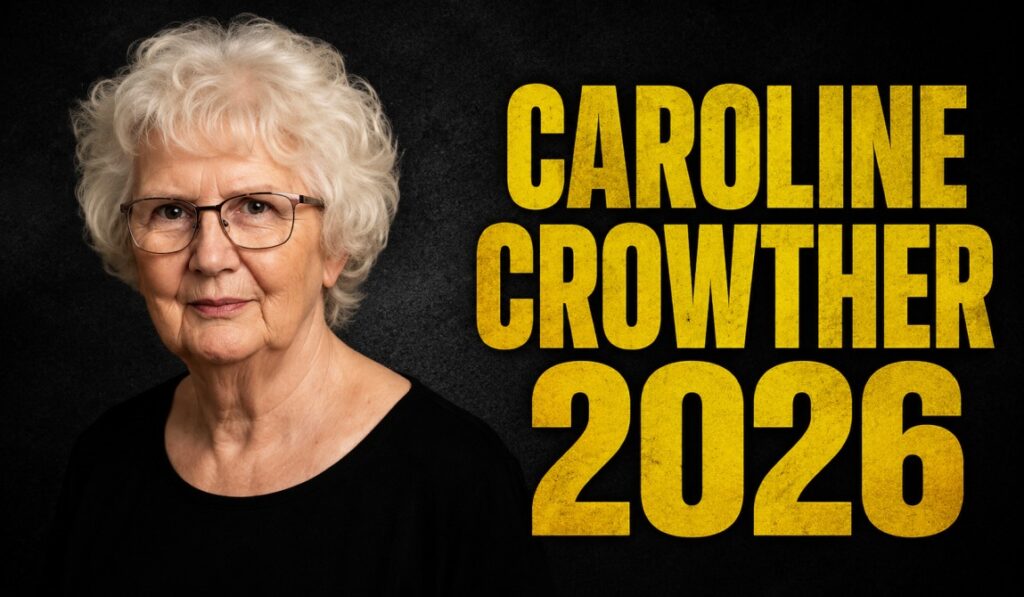
Caroline Crowther, the daughter of beloved British television personality Leslie Crowther, is one of rock history’s most quietly compelling figures. As the former wife of Phil Lynott — the iconic frontman and bassist of Thin Lizzy — she stood at the centre of one of rock music’s most turbulent love stories, yet chose a life defined by maternal strength rather than media attention. Her biography is not one of headlines and retrospectives. It is a story of resilience, private grief, and the kind of dignity that endures long after the spotlight moves on.
In 2026, interest in Caroline Crowther continues to grow — not because she has stepped forward, but because the world is finally asking better questions about the women behind rock’s greatest legends.
Early Life and Family Background
Caroline Crowther was born on December 9, 1954, into a household where public recognition was simply part of daily life. Her father, Leslie Crowther, was one of the most warmly regarded entertainers in British television history — a comedian and presenter best remembered for hosting The Price Is Right and Crackerjack. The Crowther name carried genuine affection across the United Kingdom, and growing up within it meant navigating a world of press attention, social visibility, and the expectations that accompany a famous family.
| Detail | Information |
| Full Name | Caroline Crowther |
| Date of Birth | December 9, 1954 |
| Nationality | British |
| Father | Leslie Crowther (comedian & TV presenter) |
| Married To | Phil Lynott |
| Wedding Date | February 14, 1980 |
| Children | Sarah Lynott, Cathleen Lynott |
| Known For | Wife of Thin Lizzy frontman Phil Lynott |
| Father’s Death | 1994, following a car accident |
| Current Status | Private life, no public presence |
Despite that environment, Caroline never sought the spotlight for herself. She observed the entertainment industry from a grounded distance, absorbing its rhythms without ever being consumed by them. Details about her education and early personal life remain deliberately private — a pattern of discretion she maintained consistently throughout adulthood.
Leslie Crowther’s legacy shaped more than just his career. Known for his warmth, professionalism, and genuine connection with audiences, he modelled a kind of public dignity that his daughter would later demonstrate under far more painful circumstances. When Leslie died in 1994 following injuries sustained in a car accident, Britain mourned a much-loved entertainer. Caroline, characteristically, grieved privately.
Meeting Phil Lynott and Their Marriage
By the late 1970s, Phil Lynott was a defining presence in international rock music. Thin Lizzy’s breakout track The Boys Are Back in Town had made the Dublin-born musician a household name, and Phil himself — charismatic, lyrical, and possessed of a rare emotional intelligence — was the kind of performer audiences genuinely connected with. He wrote about love, loyalty, homecoming, and loss with a rawness that felt personal rather than performed.
Caroline and Phil crossed paths through the intersecting social worlds of British entertainment and the rock circuit in the late 1970s. Their relationship developed quickly and with evident depth. On Valentine’s Day, February 14, 1980, the couple married in a private ceremony — a date that felt entirely in keeping with Phil’s romantic sensibility as a songwriter.
The marriage brought Caroline Crowther Phil Lynott wife coverage she had never previously attracted. Music press and society pages took notice. Yet even within that new visibility, Caroline remained composed and deliberately low-profile. She supported Phil’s career without performing for the cameras, attended events when appropriate, and consistently prioritised the relationship’s private reality over its public image.
Phil Lynott’s commitment to the idea of family was genuine, if complicated. His songs frequently explored themes of home, fatherhood, and belonging — ideals he held sincerely even as the demands of touring, recording, and the harder edges of rock stardom made them difficult to honour consistently.
Children and Family Life
Caroline and Phil Lynott had two daughters:
- Sarah Lynott, born December 1978 — arriving before their formal marriage, reflecting the seriousness of their relationship before they wed
- Cathleen Lynott, born July 1980 — completing the family unit Phil had long romanticised in his writing
Fatherhood brought out a dimension of Phil Lynott that the public rarely saw. Those close to the family during those years described a man genuinely moved by domestic moments — someone who treasured the quiet ordinariness of home life even as his professional existence grew increasingly chaotic. He spoke about Sarah and Cathleen with open affection in interviews, and that warmth informed how Caroline built the family’s daily rhythms.
For Caroline, motherhood became the organising centre of her life. While Phil’s world expanded through further albums, solo projects, and international tours, she focused on providing their daughters with consistency, warmth, and as much normality as their circumstances allowed. Managing a household connected to a globally touring rock musician was neither passive nor simple — it required continuous emotional effort and practical problem-solving, all of which Caroline handled with characteristic steadiness.
Her priority was always that Sarah and Cathleen experience childhood on human rather than celebrity terms. That instinct to protect rather than promote would prove essential in the years ahead.
The End of Their Marriage
By 1984, the pressures within the marriage had become unsustainable. Phil Lynott’s substance abuse — which had been a background concern for years — had escalated into something far more serious and all-consuming. What the rock world sometimes romanticised as lifestyle excess was, within the Lynott household, a source of genuine pain and instability.
The couple separated, though they never formally divorced. Phil continued to struggle through the mid-1980s, surrounded by those who cared for him but unable to arrest his deterioration. Caroline managed family life increasingly alone, carrying the weight of caring for two young daughters while watching someone she had loved deeply lose his hold on health and stability.
Phil Lynott died on January 4, 1986, aged 36. The official cause of death was heart failure, complicated by pneumonia and the direct consequences of prolonged drug use. He had collapsed on Christmas Day 1985 and never recovered. He was buried at St Fintan’s Cemetery in Sutton, County Dublin — a quiet end for one of rock’s loudest presences.
For Caroline, his death meant confronting grief that was both profound and complicated. The marriage had frayed significantly before the end, but the loss was no less real for that. There was a legacy to protect, young daughters to raise through bereavement, and a private sorrow to carry in a world that processed Phil’s death very publicly. She managed all of it with the same restraint that had defined her throughout.
Life After Phil Lynott
In the aftermath of Phil’s death, Caroline Crowther withdrew from public life entirely and deliberately. There were no memoir deals, no documentary appearances, no interviews trading on proximity to a rock legend. She made a clear choice: whatever came next would happen on her own terms, away from the attention that had always surrounded Phil’s name.
Her focus settled entirely on Sarah and Cathleen — guiding them through adolescence and into adulthood with the stable foundation she had always prioritised. Philomena Lynott, Phil’s devoted mother and the most visible keeper of his legacy in the years following his death, remained a warm presence in the girls’ lives. Caroline supported that connection without friction, understanding that her daughters’ bond with their father’s heritage mattered regardless of how the marriage had ended.
As of 2026, Caroline Crowther’s private life remains exactly that — private. There are no verified social media profiles, no confirmed interviews, and no public records of professional activity. Whether she has remarried, where she lives, what she occupies her time with — none of these details have entered the public record, because Caroline has never placed them there. This is not evasion. It is simply the life she chose.
In an era where rock widow memoirs and celebrity retrospectives have become an entire publishing genre, Caroline’s four-decade silence is itself a kind of statement. She does not appear to need the world’s understanding of who she was to Phil Lynott. She has simply moved forward.
The Legacy of Caroline Crowther
Caroline Crowther’s place in rock history is quieter than most, but it is not small. She was present during Thin Lizzy’s most creative and most destructive years. She raised Phil Lynott’s daughters through circumstances that would have unravelled many. And across four decades, she has refused — consistently and without apparent effort — to turn personal loss into public performance.
Through Sarah and Cathleen Lynott, Caroline’s influence on Phil’s legacy persists in the most human way possible. Both daughters carry their father’s name into a world that still celebrates his music, and the dignity with which they do so speaks directly to how they were raised. Tribute concerts, anniversary releases, and ongoing critical reassessment of Thin Lizzy’s catalogue continue to keep Phil’s name alive — and it is his daughters, shaped by their mother, who represent him most authentically.
Caroline’s story also challenges how rock biography tends to work. The genre gravitates toward the performer — the excess, the brilliance, the self-destruction — and reduces the surrounding women to footnotes or cautionary figures. Caroline Crowther resists that reduction entirely. She was not incidental to Phil Lynott’s story. She made serious choices under serious pressure, maintained her integrity when it would have been far easier to cash in on her proximity to fame, and raised two people who will outlast every album retrospective.
There is something of her father Leslie Crowther’s quiet composure in her — that same ability to meet difficulty with dignity rather than drama. It is, in its own way, a form of strength the rock world rarely celebrates but very much needs.
FAQs
Who is Caroline Crowther?
Caroline Crowther is a British woman born on December 9, 1954, best known as the daughter of comedian Leslie Crowther and the former wife of Thin Lizzy frontman Phil Lynott.
When did Caroline Crowther and Phil Lynott get married?
The couple married on Valentine’s Day, February 14, 1980, in a private ceremony that reflected Phil’s famously romantic sensibility.
How many children did Caroline Crowther and Phil Lynott have?
They had two daughters — Sarah Lynott, born in December 1978, and Cathleen Lynott, born in July 1980.
Were Caroline Crowther and Phil Lynott ever formally divorced?
No. The couple separated around 1984 but were never formally divorced. Phil Lynott died on January 4, 1986, before any divorce proceedings were concluded.
How did Phil Lynott die?
Phil Lynott died of heart failure complicated by pneumonia and drug-related health deterioration. He collapsed on Christmas Day 1985 and passed away nine days later on January 4, 1986, aged 36.
What is Caroline Crowther doing in 2026?
Caroline maintains a completely private life in 2026 — no confirmed social media presence, no public interviews, and no verified professional activity. She has lived entirely outside the public eye since Phil’s death.
Who was Leslie Crowther?
Leslie Crowther was one of Britain’s most popular television entertainers, known for hosting The Price Is Right and Crackerjack. He died in 1994 following a car accident.
Did Caroline Crowther ever speak publicly about Phil Lynott?
She has given very rare interviews over the decades, acknowledging the difficulty of that period while consistently emphasising her role as a mother rather than her identity as a rock star’s widow.
What was Thin Lizzy’s connection to Phil Lynott’s family life?
Phil frequently drew on themes of home, fatherhood, and belonging in his songwriting. Despite Thin Lizzy’s hard-touring lifestyle, he expressed genuine devotion to Caroline and their daughters in both interviews and his music.
Conclusion
Caroline Crowther occupies a rare position in the story of British rock — deeply connected to one of its most celebrated figures, yet entirely defined by her own choices rather than his fame. She was born into one public family, married into another level of visibility entirely, navigated profound personal loss with composure, and raised two daughters to carry a complicated legacy with grace.
Phil Lynott will always be the name people search for first. But the more you understand Caroline Crowther — her background, her decisions, her decades of quiet consistency — the more clearly you see that she is the more enduring figure. In a world that rewards spectacle, she chose substance. In a culture that profits from grief, she protected it. That, in 2026 as much as in 1986, is a story worth knowing.

I’m John Ilam, a content writer on AgeBioHub, focused on creating biography-based articles. I write about public figures, their life stories, careers, and personal backgrounds in a clear and simple way.
I keep my content focused on biographies so readers can easily find the information they’re looking for without confusion. My goal is to make every article informative, structured, and easy to read.