
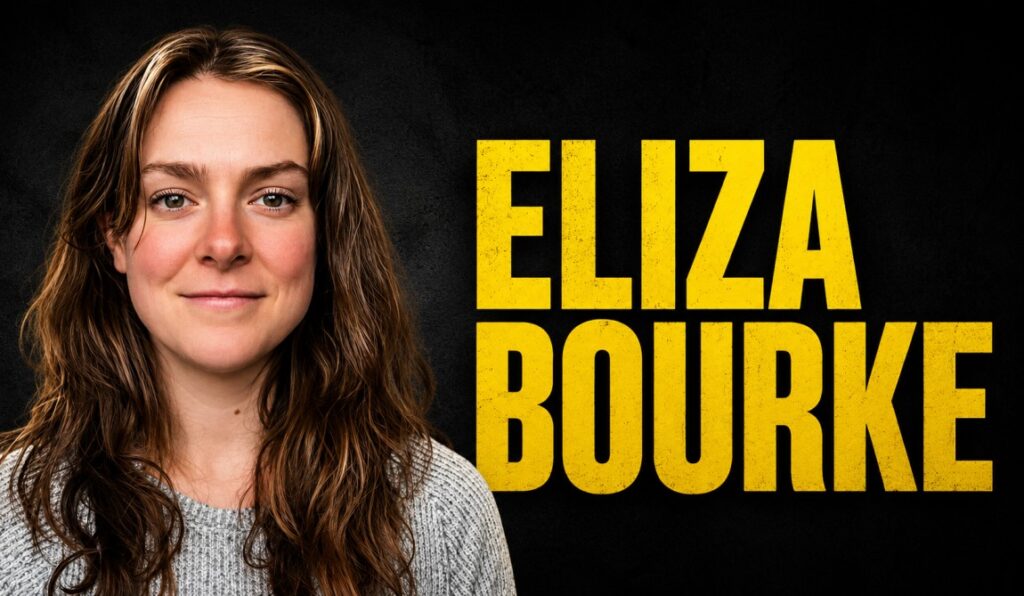
Eliza Bourke is the younger daughter of celebrated British comedian, writer, and television presenter Jo Brand, and her husband Bernie Bourke, a former psychiatric nurse with decades of experience in the mental health sector. Born in approximately November 2002 in the United Kingdom, Eliza has grown up entirely outside the public sphere — a conscious, sustained choice that sets her apart from almost every other child raised in the orbit of British celebrity culture.
In 2026, public curiosity around Eliza Bourke continues to grow, largely because so little verified information about her exists. She has no public social media presence, has given no interviews, and has made no documented public appearances tied to her mother’s television career. For a generation raised on Instagram grids and TikTok highlights, her near-total invisibility online feels almost radical. Yet it is entirely deliberate.
This complete biography covers everything currently known about Eliza — her family background, her academic journey at Goldsmiths, University of London, her values, her relationship with her parents, and why her quiet, private path is itself a story worth understanding in full.
Bio Table
| Detail | Information |
| Full Name | Eliza Bourke |
| Date of Birth | November 2002 (approximate) |
| Age (2026) | Approximately 23 years old |
| Nationality | British |
| Birthplace | United Kingdom |
| Mother | Jo Brand (comedian, TV presenter, writer) |
| Father | Bernie Bourke (former psychiatric nurse) |
| Sibling | Maisie Bourke (older sister, musician, Loud LDN) |
| University | Goldsmiths, University of London |
| Field of Study | Education Studies (BA) |
| Professional Role | Part-time nanny (since October 2021, reported) |
| Social Media | Private Instagram and Facebook — not publicly accessible |
| Known For | Jo Brand’s daughter; private lifestyle; education advocacy |
| Residence | United Kingdom |
The Bourke-Brand Family: An Overview
Understanding Eliza Bourke requires understanding the household that formed her — one built not on glamour or celebrity ambition, but on empathy, social awareness, and intellectual honesty.
Jo Brand, Eliza’s mother, is among the most respected and recognisable figures in British comedy. Her career began in the late 1980s with stand-up performances that were considered bold and boundary-pushing for their time, and she has remained a constant presence on British television ever since. Audiences across the UK know her from panel shows such as Have I Got News for You, from her long-running work in comedy writing, and from her warm, dry-humoured role hosting The Great British Bake Off: An Extra Slice. Jo has never used her platform merely for laughs — she has consistently directed attention toward mental health awareness, the pressures facing NHS workers, and the structural failures that affect vulnerable communities. Her comedy has always carried social weight.
What is less often discussed publicly is the consistency with which Jo Brand has protected her family from the media. In various interviews over the years, she has made her position clear: fame is her professional circumstance, not her family’s identity. Her daughters were raised to understand the difference between the two.
Bernie Bourke, Eliza’s father, worked for many years as a psychiatric nurse before stepping back from that career. His professional background in mental health — a field that demands extraordinary emotional intelligence, ethical care, and attentiveness to human suffering — has clearly informed the Bourke family’s broader values. Bernie’s quiet influence runs through much of what Jo has publicly championed regarding mental health reform and community wellbeing in the UK.
Maisie Bourke, Eliza’s older sister born in 2001 and known professionally as Maisi, has taken a markedly different approach to public life. As a musician, content creator, and co-founder of the Loud LDN music collective, Maisie has built an active digital presence across Instagram and TikTok, sharing her creative work with a growing audience. Her career represents one entirely valid response to growing up in a high-profile household. Eliza’s response — choosing complete privacy — represents another. Together, the two sisters demonstrate that the same upbringing can produce entirely different, equally valid ways of moving through the world.
Eliza Bourke: A Life Out of the Spotlight
Eliza Bourke was born into one of the UK’s more quietly prominent families, yet she has spent her entire life stepping deliberately away from the attention that family name could attract. In an era when personal branding begins in secondary school and social media visibility is treated as professional currency, her consistent refusal to be seen is genuinely unusual.
Sources suggest she was born in November 2002, placing her at approximately 23 years of age in 2026. Beyond that, the biographical record thins considerably. No verified public photographs of Eliza have been widely circulated. No documented quotes, interviews, or professional appearances exist in the public domain. What reaches the public comes almost entirely through indirect references — details mentioned by family, or fragments pieced together from her limited academic and community footprint.
This is not the result of a sheltered or uneventful life. Rather, it reflects a young woman who has made a considered, ongoing decision to live outside public scrutiny. The absence of information about Eliza Bourke is itself the information: she does not want to be tracked, discussed, or defined by an audience that has no genuine claim on her.
That choice carries real meaning in 2026. The dominant cultural assumption — that visibility equals relevance, that being searchable means mattering — is one that Eliza appears to have evaluated and rejected entirely. Her celebrity family background gave her every tool to build a public profile. Her decision not to use those tools speaks to a clarity of values that is rare at any age.
Eliza Bourke’s Relationship with Jo Brand and Bernie Bourke
The relationship Eliza shares with her parents has never been discussed openly in the public record. What can be understood comes from reading Jo Brand and Bernie Bourke as the people they demonstrably are — and considering what kind of home two such people would have built for their children.
Jo Brand has, across decades of interviews, maintained a firm and consistent position: her family is not a public asset. She has spoken about raising her daughters with a sense of normalcy and personal autonomy, deliberately separating the performance of her professional life from the reality of family life at home. The lesson this communicates to children is a significant one — that worth is not measured in recognition, and that a life lived away from cameras is not a lesser life.
The emotional intelligence that characterises Jo’s best comedy work — her ability to hold difficult truths lightly, to find compassion in absurdity — very likely informed how she parented. Children raised by someone with that quality of awareness tend to develop strong internal compasses, a capacity to assess situations on their own terms rather than deferring to outside opinion.
Bernie Bourke’s contribution is equally substantial, if less visible. Psychiatric nursing as a profession requires a person to sit with others in their most vulnerable moments — to listen without judgement, to support without controlling, to hold space without imposing solutions. Those qualities, practiced daily across a career, do not disappear at the front door. A father shaped by that vocation would likely have offered Eliza exactly what she appears to carry: a grounded sense of identity, a comfort with quietness, and a genuine respect for personal boundaries — her own and those of others.
The environment Jo and Bernie created gave their daughters roots in the form of strong shared values, and genuine freedom in the form of permission to become whoever they actually are. For Eliza, that freedom has led inward and outward simultaneously — toward serious academic work, toward community contribution, and away from the performance of self that public life demands.
Eliza Bourke’s Education and Career
Among the most significant publicly known details about Eliza Bourke is her academic path. She is reported to be studying for a Bachelor of Arts in Education Studies at Goldsmiths, University of London — an institution known for its progressive intellectual culture, its strength in the arts and social sciences, and its consistent engagement with questions of equity and social justice.
Education Studies as a discipline is far broader than its name suggests. It draws on sociology, psychology, political theory, and philosophy to examine how learning systems function, who they serve, and who they fail. Students in this field engage with questions around Special Educational Needs (SEN), inclusive pedagogy, emotional-based school avoidance, child welfare, and the relationship between educational access and social inequality. These are not abstract concerns — they are the structural questions that determine the life outcomes of millions of young people across the UK.
That Eliza has chosen this field is not incidental. It reflects a set of priorities — compassionate values, social awareness, commitment to systemic change — that connect directly to her family background. A mother who has spent decades drawing public attention to mental health, and a father whose career was built on caring for people in psychological crisis, would naturally raise a daughter with heightened sensitivity to how institutions either support or abandon the people who depend on them.
Alongside her university studies, Eliza is reported to have been working as a part-time nanny since October 2021, caring for children aged between seven and fourteen. This practical, hands-on experience has given her direct insight into child development, family dynamics, and the real-world challenges that educational theory often oversimplifies. It has deepened her understanding of how homework support, emotional regulation, and structured routine function in children’s lives outside of school — the kind of understanding that cannot be acquired from textbooks alone.
During her time at Goldsmiths, Eliza has reportedly also taken on a role as a Student Community Leader, contributing to events including Welcome Week and Winter Social, and participating in student engagement and governance panels. These leadership roles reflect a person who is not passively moving through her education, but actively investing in the community around her — building the kind of collaborative, inclusive environment she believes education should reflect.
Her long-term career goals, as understood from available information, point toward education policy, community mental health advocacy, and the integration of emotional support structures within mainstream schooling. She has expressed interest in contributing to government departments, non-profit organisations, or international bodies working to make educational systems more equitable and psychologically supportive for all learners, including those with learning differences and emotional support needs.
This is not a career path that leads toward television studios or social media influence. It leads toward classrooms, policy documents, community programmes, and the kinds of institutional change that rarely makes headlines but quietly shapes the conditions in which young people grow up. Eliza Bourke, in other words, appears to be orienting her professional future toward the kind of impact her parents have always modelled: substantial, compassionate, and largely invisible to those not directly affected by it.
Eliza Bourke’s Presence on Social Media
In the current information landscape, a person’s relationship with social media is often treated as a window into their identity. By that logic, Eliza Bourke is almost entirely opaque — and that is entirely by design.
She is understood to hold accounts on both Instagram and Facebook, but both profiles are set to private. Neither platform offers any publicly accessible content, photographs, or identifying information. To anyone not personally approved by Eliza, her digital presence simply does not exist. In practical terms, her online footprint is as close to invisible as a person in their early twenties can realistically achieve.
The contrast with her sister Maisie Bourke is sharp and instructive. Maisie uses her social media presence as an active professional instrument — sharing music, building community around the Loud LDN collective, and cultivating the kind of authentic digital persona that is increasingly essential to careers in the UK independent music scene. For Maisie, being online is part of working. For Eliza, being offline is part of living.
This is not an accident of circumstance or a result of technological unfamiliarity. Eliza is 23 years old in 2026 — she grew up with smartphones, has studied at a major London university, and is by all indications an engaged, thoughtful young person. Her absence from public social media is a deliberate choice, maintained consistently over time despite the considerable social and professional pressure that comes with being a young adult in a digital-first world.
What that choice reflects is a clear-eyed understanding of what public-facing social media actually costs: the loss of control over one’s own narrative, exposure to unsolicited attention and commentary, and the reduction of a complex human life to a curated sequence of images and captions. For someone connected — however indirectly — to a well-known public figure, those costs are amplified. Eliza has assessed the trade-off and consistently declined it.
Her digital privacy is, in this sense, not merely personal preference. It is an act of sustained self-determination in an environment designed to make such determination difficult.
FAQs
Who exactly is Eliza Bourke?
She is the younger daughter of British comedian Jo Brand and former psychiatric nurse Bernie Bourke, currently studying Education Studies in London.
What is Eliza Bourke’s age in 2026?
Born in approximately November 2002, Eliza is around 23 years old as of 2026.
Where does Eliza Bourke currently study?
She is reported to be enrolled at Goldsmiths, University of London, pursuing a BA in Education Studies.
Does Eliza Bourke have a sister?
Yes — her older sister is Maisie Bourke (born 2001), a musician and co-founder of the London-based music collective Loud LDN.
Is Eliza Bourke active on Instagram or TikTok?
She holds private Instagram and Facebook accounts but maintains no publicly accessible social media presence whatsoever.
What career path is Eliza Bourke pursuing?
She is focused on education policy, student wellbeing, and community mental health advocacy, with goals in inclusive educational reform.
Why does Eliza Bourke avoid public attention?
She appears to value personal autonomy and privacy over public visibility — a deliberate choice consistent with how her parents raised her, away from media scrutiny.
What practical work experience does Eliza have?
She has worked as a part-time nanny since October 2021, supporting children aged seven to fourteen with development, schoolwork, and daily routines.
How is Eliza Bourke different from her sister Maisie?
While Maisie has embraced a public creative career, Eliza has chosen a quiet, academically focused path entirely outside the entertainment industry.
Conclusion
Eliza Bourke does not seek attention, and she has never needed to. Her story carries its own quiet weight precisely because it runs so deliberately against the current of the culture she was born into.
She could have leveraged her mother’s name, cultivated a digital following, or stepped into any number of the doors that Jo Brand’s profile might have opened. Instead, she enrolled at Goldsmiths, studied a discipline rooted in compassion and systemic change, cared for children as a working nanny, led community initiatives at university, and kept her personal life firmly, resolutely private. These are not the choices of someone who lacks ambition. They are the choices of someone whose ambitions point inward and outward at once — toward genuine understanding and meaningful contribution, not toward recognition.
What the Bourke family ultimately represents is something uncommon in British public life: a household where fame was treated as a job, not an identity. Jo Brand worked in television; she did not make her family into television. Bernie Bourke worked in psychiatric care; he brought that care home without turning it into performance. The result is two daughters — one public, one private — each entirely herself, each operating on her own terms.
Eliza Bourke in 2026 is a young woman at the early stages of what will likely be a quietly impactful career in education and social advocacy. She will probably never be famous in the way her mother is. She appears to have no interest in being so. And that, more than anything else in this biography, is what makes her worth knowing about.

I’m John Ilam, a content writer on AgeBioHub, focused on creating biography-based articles. I write about public figures, their life stories, careers, and personal backgrounds in a clear and simple way.
I keep my content focused on biographies so readers can easily find the information they’re looking for without confusion. My goal is to make every article informative, structured, and easy to read.