
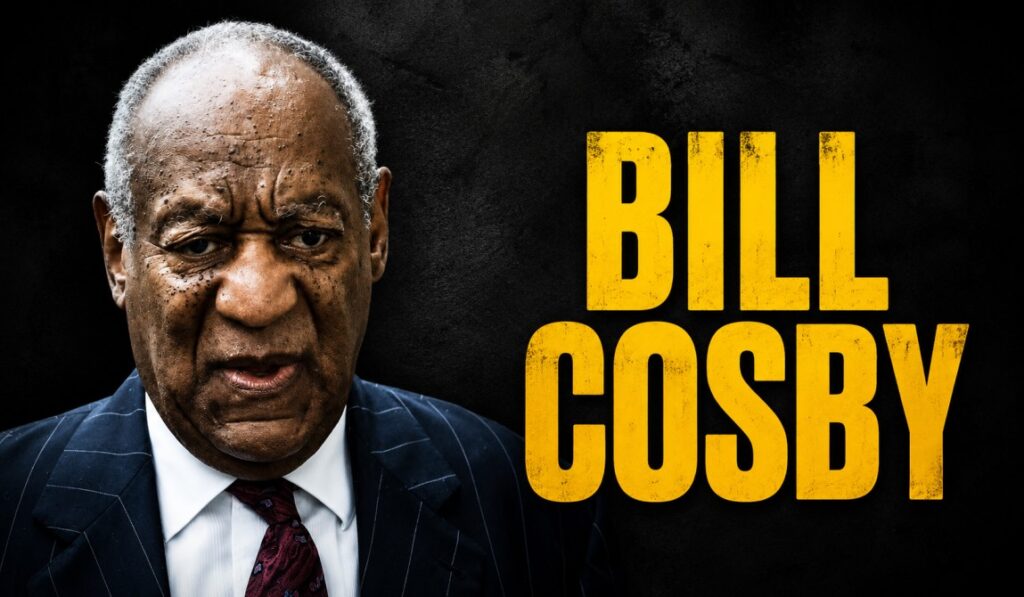
Bill Cosby — the name alone carries the weight of two entirely opposite legacies. For millions of Americans who grew up watching The Cosby Show through the 1980s and early 1990s, he was the warm, witty, and wise Dr. Cliff Huxtable — a character so beloved that Cosby himself earned the title “America’s Dad.” Yet the same man who reshaped Black representation in American television, shattered racial barriers in stand-up comedy, and accumulated one of the most decorated award portfolios in entertainment history now lives in near-complete isolation, legally blind, financially battered, and surrounded by attorneys rather than audiences.
As of 2026, Bill Cosby is 88 years old. He no longer performs. He no longer gives interviews. His Manhattan properties have been sold off to cover mounting civil judgments, and his fortune — once estimated at $400 million at its peak — has been hollowed out by over a decade of legal warfare. This comprehensive biography traces the full arc of his life: from a public housing project in North Philadelphia to the heights of American celebrity, and then through one of the most consequential falls from grace in modern entertainment history.
PROFILE DETAILS
| Field | Details |
| Full Name | William Henry Cosby Jr. |
| Known As | Bill Cosby |
| Date of Birth | July 12, 1937 |
| Age | 88 years old (2026) |
| Birthplace | Philadelphia, Pennsylvania, USA |
| Birth Sign | Cancer |
| Nationality | American |
| Height | Approximately 6′ 1″ (185 cm) |
| Weight | Not publicly disclosed |
| Profession | Former Comedian, Actor, Producer, Author |
| Active Career Years | 1961–2014 |
| Spouse | Camille Hanks Cosby (married January 25, 1964) |
| Children | Erika, Erinn, Ensa (d. 2018), Evin, Ennis (d. 1997) |
| Parents | William Henry Cosby Sr. and Anna Pearl Cosby |
| Estimated Net Worth | $50M–$400M (heavily illiquid; contested) |
| Primary Income Sources | Syndication residuals, art collection, real estate liquidation |
| Religion | Not publicly disclosed |
| Social Media | X and Facebook accounts managed by representatives |
Executive Summary
Few figures in American cultural history have experienced a transformation as total and as irreversible as Bill Cosby’s. During the peak years of his career, he was not simply a successful entertainer — he was a cultural institution. His work on I Spy in the 1960s made him one of the first Black actors to headline a dramatic network television series. His nine Grammy Awards for comedy recording set a benchmark no one has matched. And The Cosby Show, which ran from 1984 to 1992, did something far beyond winning ratings — it fundamentally altered how mainstream America perceived Black professional family life.
That foundation, built across five decades of genuine artistic achievement, began fracturing publicly in 2014 when a wave of sexual misconduct allegations — eventually involving more than 60 women — moved from the margins of public awareness to the front pages of every major news outlet. By 2018, Cosby stood convicted of aggravated indecent assault in a Pennsylvania courtroom and was sentenced to three to ten years in state prison.
The Pennsylvania Supreme Court overturned that conviction in 2021 on due process grounds, specifically citing a prior immunity agreement that prosecutors had violated. He walked free, but into a world that had fundamentally moved on. No network welcomed him back. No venue booked him. No endorsement partner returned his calls. The post-#MeToo era had permanently closed the professional doors that his legal victory technically reopened.
By April 2026, Cosby’s daily existence consists of managing civil litigation, monitoring the liquidation of assets, and living quietly at his Elkins Park, Pennsylvania estate with his wife Camille. His story has become less about comedy or television and more about what happens when fame, power, accountability, and the law collide over decades — a cautionary tale that resonates far beyond the entertainment industry.
What Is Bill Cosby’s Net Worth and Salary?
Bill Cosby’s net worth in 2026 sits at the center of an ongoing financial debate, with estimates spanning a wide range from approximately $50 million on the liquid end to as high as $400 million in gross asset value. Understanding that gap is essential to understanding his actual financial condition.
The higher figure reflects the paper value of assets Cosby still technically owns — most significantly, a blue-chip art collection valued at over $150 million, assembled over decades and featuring works by prominent African American artists. On paper, that collection alone would make him extraordinarily wealthy. In practice, art at that scale is not quickly or easily converted to cash. Auction processes for major collections take months to years, require specialist handling, and rarely yield full estimated valuations in distressed circumstances.
His liquid wealth — money accessible for day-to-day expenses, legal fee payments, and debt servicing — has deteriorated dramatically. In a 2026 legal deposition, Cosby described his financial decline in vivid terms, comparing his net worth trajectory to a vessel sinking without any means of propulsion. That description, while colorful, is financially accurate. He has had zero active professional income since approximately 2014, while legal expenses have compounded annually for over a decade.
The most significant single financial event of recent years came in March 2026, when a California civil jury awarded plaintiff Donna Motsinger $59.25 million in damages — one of the largest individual judgments in his civil litigation history. That verdict accelerated asset liquidation urgency considerably. In November 2025, Cosby sold his premier Manhattan townhouse on East 71st Street for $28 million, a sale widely understood as a debt-management maneuver rather than a voluntary portfolio decision. A second East 61st Street Manhattan property remained listed at approximately $5.99 million as of April 2026.
His only recurring income consists of syndication residuals from The Cosby Show, which continue to diminish as streaming platforms and broadcast networks have largely removed the series from active rotation. He draws no salary, holds no endorsement contracts, and has no performance bookings of any kind.
Early Life
William Henry Cosby Jr. entered the world on July 12, 1937, in Philadelphia, Pennsylvania — a city whose working-class rhythms and street-level humor would become the bedrock of his comedic voice. He spent his childhood in the Richard Allen Homes, a public housing development in North Philadelphia, where economic hardship was a constant backdrop to daily life.
His family structure was fragile from early on. His mother, Anna Pearl Cosby, kept the household running by working as a domestic employee, cleaning homes for wealthier Philadelphia families. His father, William Henry Cosby Sr., served in the United States Navy as a mess steward but was absent for long stretches of Bill’s childhood — a pattern that placed significant emotional and practical responsibility on young Bill’s shoulders as the eldest son.
Despite those pressures, Cosby emerged as a natural athlete and community leader during his school years. He captained both his baseball and track teams, displayed genuine physical talent, and earned the admiration of peers who recognized his competitive drive. Academically, however, he struggled to maintain consistent engagement. When faced with the prospect of repeating the tenth grade, he chose instead to enlist in the U.S. Navy, where he served as a hospital corpsman — a medical support role that required discipline, adaptability, and human empathy, all qualities that later shaped his storytelling instincts.
The Navy years proved transformative in multiple ways. Cosby earned his high school equivalency diploma during his service, laying the educational foundation he had previously been unable to build. After his honorable discharge, he secured an athletic scholarship to Temple University in his hometown — a remarkable turnaround for a young man who had dropped out of high school just years earlier. At Temple, he excelled at high jump and football while simultaneously discovering that making people laugh came to him as naturally as any athletic discipline. His comedy career began pulling at him with increasing force, eventually leading him to leave academia before completing his undergraduate degree — though he would return years later, ultimately earning a doctorate in Education, a credential that mattered deeply to him personally.
Awards
The recognition Bill Cosby accumulated over his active career reflected a performer operating at the highest levels across multiple entertainment formats simultaneously. His award history is not merely impressive — it is historically significant in ways that extend beyond individual trophies.
Emmy Awards: Cosby won four Primetime Emmy Awards, three of them consecutively for his lead dramatic performance in I Spy. That achievement made him one of the first Black performers to win the Emmy for Outstanding Lead Actor in a Dramatic Series — a barrier-breaking accomplishment that arrived at a particularly charged moment in American civil rights history.
Grammy Awards: His nine Grammy wins, including seven in the Best Comedy Album category, represent a record in that field that remains unbroken. His comedy recordings of the 1960s and 1970s were not simply popular — they defined what stand-up comedy albums could sound like and how observational humor rooted in family and childhood could connect across racial and cultural lines.
Golden Globe Awards: Two wins recognized his television work at the industry level.
Presidential Medal of Freedom: Awarded in 2002 by President George W. Bush, this honor represented the highest civilian recognition the United States government offers. It has not been formally revoked, though its moral weight has been widely questioned in public discourse.
Mark Twain Prize for American Humor: Presented by the Kennedy Center in 2009, this award was formally revoked in 2018 following his criminal conviction — one of the most visible institutional repudiations of his legacy and a rare instance of a major arts organization withdrawing one of its signature honors.
Kennedy Center Honors: Received in 1998 at the height of his respected public standing.
Beyond these major awards, Cosby received dozens of honorary doctoral degrees from universities across the country — the vast majority of which were revoked following the emergence of the sexual misconduct allegations and subsequent conviction. The scale of that revocation wave was itself historically unprecedented in American academic culture.
Personal Life and Relationships
Bill Cosby and Camille Hanks married on January 25, 1964, beginning a union that has now endured for more than six decades — longer than most Hollywood marriages survive even without the extraordinary pressures the Cosbys have weathered. Camille was a college student when they met, and the relationship developed during the early years of Cosby’s rising comedy career.
The marriage has survived circumstances that would have dissolved virtually any other partnership. Cosby’s acknowledged extramarital affairs, his very public exposure as the subject of sexual assault allegations from more than 60 women, his 2018 criminal conviction, his incarceration, and his 2021 release have all unfolded with Camille positioned as his most consistent and outspoken defender.
Her loyalty has not been passive. Camille Cosby has publicly questioned the motives of prosecutors, challenged the narratives of accusers, and issued pointed statements through media channels defending her husband’s character and contesting the legal processes that led to his conviction. At the same time, she has taken on a substantive role as the de facto manager of the Cosby financial estate, making decisions about asset management, legal strategy priorities, and property transactions that directly affect what remains of the family’s wealth.
Cosby has admitted in various legal proceedings to extramarital sexual encounters, and the broader pattern of behavior alleged by dozens of women across multiple decades has been extensively documented through civil depositions and media reporting. His criminal conviction was overturned not on the basis that the conduct did not occur, but on procedural due process grounds — a legal distinction that his accusers and advocates have consistently highlighted in public discourse.
As of 2026, the Cosbys’ social world has contracted to an extremely tight circle. Their relationship, whatever its private dynamics, functions publicly as a managed partnership navigating the final legal and financial chapters of an extraordinary and deeply troubled life.
Family Life
The private history of the Cosby family is marked by genuine tragedy that exists entirely apart from the legal controversies that have defined Bill’s public image in later years. Together, Bill and Camille Hanks Cosby raised five children: daughters Erika, Erinn, Ensa, and Evin, and their only son, Ennis William Cosby.
Ennis Cosby was murdered on January 16, 1997. He was 27 years old, changing a flat tire on Interstate 405 in Los Angeles when he was approached and shot by Mikhail Markhasev, a Ukrainian immigrant who was subsequently convicted of first-degree murder. Ennis had been a passionate advocate for dyslexia awareness, having navigated the learning disability himself, and had dedicated his adult life to helping others manage similar challenges. His death shattered the family and triggered an outpouring of national grief. Bill Cosby spoke publicly about the loss with a rawness that connected with millions of parents, temporarily deepening public affection for him at a profoundly painful personal moment.
Ensa Cosby died in February 2018 at the age of 44, succumbing to renal failure while her father was actively standing trial in a Pennsylvania criminal court. The timing of her death — in the middle of the most publicized legal proceedings of his life — created an agonizing convergence of private grief and public spectacle.
As of 2026, Bill Cosby resides at the family’s Elkins Park, Pennsylvania estate, a 3-acre property that has become the fixed center of his increasingly constrained world. His progressive blindness has added physical dependency to his legal and financial vulnerabilities. He travels rarely, speaks publicly almost never, and relies on Camille and his surviving daughters for both personal support and practical daily care.
Associated With
Robert Culp — Cosby’s co-star in the landmark NBC series I Spy, which aired from 1965 to 1968 and represented a genuine milestone in American television history as one of the first network dramas to cast a Black actor in an equal lead dramatic role alongside a white co-star. Culp and Cosby’s on-screen chemistry translated into a lasting real-world friendship. The series earned Cosby three consecutive Emmy Awards and established his credibility as a dramatic performer well beyond the comedy world.
Phylicia Rashad — Best known to audiences as Clair Huxtable, the accomplished attorney and devoted mother who anchored The Cosby Show alongside Cosby’s Cliff Huxtable from 1984 to 1992, Rashad later reprised a co-starring role in Cosby (1996–2000). She generated significant controversy when she publicly defended Cosby during the height of the misconduct allegations, a position that drew particular scrutiny given her subsequent appointment as Dean of the College of Fine Arts at Howard University.
Andrew Wyatt — Cosby’s publicist and primary public spokesperson, Wyatt has remained one of the most consistently vocal defenders of Cosby’s reputation throughout the legal saga. He continues to issue statements on health matters, litigation developments, and public perception management on Cosby’s behalf as of 2026.
Real Estate
At the height of his financial power, Bill Cosby’s real estate portfolio represented both substantial wealth and a very deliberate projection of status — particularly his Manhattan properties, which placed him among New York City’s most prominent cultural figures. That portfolio has been systematically reduced in recent years under the pressure of civil litigation judgments and mounting legal expenses.
Elkins Park, Pennsylvania — Cosby’s primary residence is a 3-acre private estate in this Montgomery County suburb of Philadelphia. He currently lives here with Camille, and as of 2026, this property has not been listed for sale. It represents the last major residential anchor of his domestic life.
Shelburne Falls, Massachusetts — A 21-acre rural compound in western Massachusetts that has served as a private family retreat over the years. This property remains in the Cosby estate’s holdings.
Manhattan, New York — East 71st Street — The sale of this prestigious Upper East Side townhouse for $28 million in November 2025 was one of the most significant recent financial events in Cosby’s legal-era asset management. The transaction was widely understood as a necessary response to debt obligations, not a voluntary portfolio decision. This property had long been considered the crown jewel of his urban holdings and a symbol of his peak-era financial stature in New York.
Manhattan, New York — East 61st Street — A second Manhattan townhouse listed at approximately $5.99 million as of April 2026 and still unsold at that time. With both properties either sold or on the market, Cosby’s New York City real estate presence has effectively vanished.
The broader pattern across his property holdings tells a consistent story: forced sales driven by legal liability rather than strategic financial planning, reducing a once-impressive multi-city real estate portfolio to a single primary residence.
Net Worth History
| Period | Estimated Worth | Driving Factors |
| 1990s Peak | $300M – $400M | Massive syndication income from The Cosby Show; active touring and endorsements |
| 2015 | ~$400M | Gross asset value intact; professional income begins to freeze as allegations resurface |
| 2018 | ~$300M | Criminal conviction; complete collapse of bookings, endorsements, and broadcast deals |
| 2021 | ~$250M | Three years of legal fees during incarceration; continued asset devaluation |
| 2023 | ~$150M | Multiple civil lawsuit judgments; real estate liquidation begins |
| 2026 | $50M–$100M liquid / up to $400M gross | $59.25M Donna Motsinger judgment; East 71st St. Manhattan sale for $28M |
The pattern embedded in this timeline reflects a financial reality common to high-profile legal defendants whose income disappears entirely while litigation costs compound without pause. Cosby’s situation is particularly severe because his art collection — the single largest component of his gross asset value — is not the kind of asset that can be converted to cash quickly or at full valuation under distressed conditions. Blue-chip African American art holdings of that scale require careful, extended auction processes to realize anything approaching their appraised worth.
FAQs
How old is Bill Cosby in 2026?
He is 88 years old, born July 12, 1937, in Philadelphia, Pennsylvania.
What is Bill Cosby’s net worth in 2026?
Estimates range between $50 million liquid and up to $400 million in gross assets, though accessible wealth has declined sharply.
Is Bill Cosby still married to Camille Cosby in 2026?
Yes — they have been married since January 25, 1964, and Camille remains his primary personal and financial support.
Why was Bill Cosby’s 2018 criminal conviction overturned?
The Pennsylvania Supreme Court reversed it in 2021 citing due process violations connected to a prior prosecutorial immunity agreement.
How many women accused Bill Cosby of sexual misconduct?
Over 60 women publicly alleged sexual misconduct spanning multiple decades of his career.
What happened to Bill Cosby’s son Ennis Cosby?
Ennis was fatally shot during a robbery while changing a tire on a Los Angeles highway on January 16, 1997, at age 27.
Does Bill Cosby still receive money from The Cosby Show?
He earns diminishing residual payments from syndication, but no active salary, performance fees, or endorsement income exists.
Where does Bill Cosby live now?
He resides at his private 3-acre estate in Elkins Park, Pennsylvania, with his wife Camille.
What is Bill Cosby’s most valuable remaining asset?
His blue-chip art collection, valued at over $150 million, is considered the largest remaining component of his gross estate.
Conclusion
Bill Cosby’s life in 2026 is a story that resists easy summarization precisely because it contains two entirely real and irreconcilable truths. The first is that he was, by any objective measure, one of the most consequential entertainers in American television and comedy history — a man who broke racial barriers at a critical moment in the nation’s social evolution, who made the country laugh across generations, and who built a cultural and financial legacy of extraordinary scale.
The second truth is equally real: that legacy was built alongside a pattern of conduct that caused serious harm to many people over many decades, and that the legal and financial consequences of that conduct have now consumed virtually everything he once built.
What remains of his daily life is a quiet, constrained, legally complicated existence on a Pennsylvania estate — an 88-year-old man who is legally blind, financially diminished, professionally finished, and still fighting civil lawsuits with whatever resources he has left. The Donna Motsinger judgment, the Manhattan property sales, the revoked awards, and the dwindling syndication checks are not footnotes to his story. They are its current chapters.
Bill Cosby’s place in American cultural memory is now permanently layered — the comedy pioneer and the convicted defendant, the trailblazer and the cautionary figure, inseparable from each other in the historical record, and unlikely to be uncoupled by anything that follows.

I’m John Ilam, a content writer on AgeBioHub, focused on creating biography-based articles. I write about public figures, their life stories, careers, and personal backgrounds in a clear and simple way.
I keep my content focused on biographies so readers can easily find the information they’re looking for without confusion. My goal is to make every article informative, structured, and easy to read.