
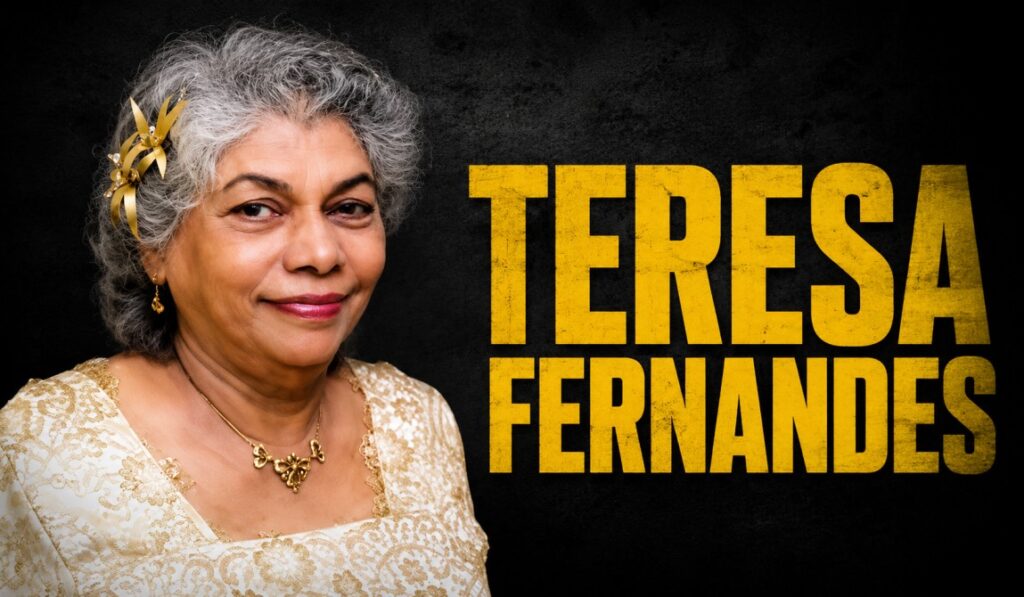
Teresa Fernandes is one of those genuinely uncommon names that commands steady digital attention without the traditional scaffolding of a documented career, verified achievements, or an authenticated public profile. In a media landscape overflowing with influencers, reality stars, and self-promoted personalities, her real identity stands as something altogether different — a subject of sustained curiosity that draws energy from ambiguity rather than exposure. Most people encounter her name by accident, while searching for an entirely unrelated figure, yet the mystery surrounding her background proves compelling enough to hold their attention.
What makes Teresa Fernandes in 2026 a genuinely interesting subject is precisely what remains unconfirmed. Her personal history, professional path, and social connections exist largely outside the boundaries of any verifiable public record, generating a steady stream of speculation-driven searches that keep her name circulating long after any initial trigger has faded. This pattern reveals something significant about how modern search culture processes the unknown — and how the complete absence of information can, paradoxically, function as a self-sustaining source of public intrigue.
This article examines everything that can be honestly and responsibly documented about Teresa Fernandes — her alleged associations, her confirmed absence from public records, the digital misinformation cycles that have shaped her online reputation, and what her broader story tells us about the way biographical narratives get constructed around figures who never chose to become subjects of one.
Quick Bio Table for Teresa Fernandes
| Field | Details |
| Full Name | Teresa Fernandes |
| Known For | Search-driven online recognition and curiosity-based digital prominence |
| Profession | Undisclosed; no verified public-facing career on record |
| Nationality | Believed to be Indian based on indirect contextual references |
| Age | Not publicly confirmed; no verified birth records available |
| Public Presence | Minimal; absent from mainstream media and entertainment directories |
| Fame Trigger | Name confusion, viral associations, and algorithmic search repetition |
| Personal Life | Entirely private; no confirmed personal disclosures of any kind |
| Social Media | No authenticated accounts identified across major platforms |
| Notable Characteristics | Anonymity-driven prominence; speculation-based public identity |
| Current Status | Outside active public life; interest maintained by ongoing digital curiosity |
Who Is Teresa Fernandes?
Teresa Fernandes holds a genuinely peculiar position within the contemporary digital identity landscape. She carries no celebrity credentials in any traditional sense — no award nominations surface under her name, no verified professional history appears in industry databases, and no credible biographical publication has ever dedicated documented space to her story. And yet, across search engine results, discussion threads, and content aggregator pages, her name generates traffic volumes that place her firmly within the category of curiosity-driven public interest figures — even if the precise nature of that interest proves remarkably difficult to pin down.
The engine driving her online visibility appears to be a compounding interaction between name-based identity confusion and the self-reinforcing mechanics of search behaviour. When a name appears repeatedly across unconnected platforms without clear explanatory context, search algorithms begin treating that repetition as a relevance signal, which accelerates indexing, multiplies results, and draws in fresh waves of curious readers. This feedback loop operates entirely independently of whether the subject has accomplished anything worth noting, producing what might be described as pure attention without biographical foundation.
What sets Teresa Fernandes apart from other low-profile private individuals is that this attention has demonstrated genuine staying power. Most people who live outside public life simply remain invisible in search ecosystems. She does not follow that pattern. The combination of unresolved identity questions, indirect associations with documented personalities, and a complete absence of first-person clarification has created a profile that continuously regenerates curiosity. In 2026, she remains fundamentally open-ended — a subject whose story appears either still unwritten or deliberately withheld from public view.
The Private Life of Teresa Fernandes
The degree to which Teresa Fernandes’ personal life has remained outside documented record is, by any reasonable standard, remarkable. In a media environment where even genuinely private individuals eventually leave traceable footprints — a court document, a community mention, a property filing — her personal narrative has maintained a biographical silence that is almost complete. No verified interviews exist. No published personal statements have circulated through credible channels. No firsthand accounts from people who know her have entered any form of accessible public record.
This level of personal information privacy invites two competing interpretations worth considering separately. The first treats her anonymity as a conscious and maintained choice — a deliberate refusal to participate in the public disclosure culture that governs most recognisable names in 2026. The second, arguably more structurally interesting interpretation, raises the possibility that the Teresa Fernandes generating search-driven prominence may be largely a constructed digital composite — an identity assembled from misattributed details, assumed connections, and speculative content that has drifted away from any single real person.
Neither reading can be confirmed, and that fundamental uncertainty is itself central to what keeps public fascination alive. Her private life is defined not by the richness of what it contains but by the striking completeness of what it withholds. By declining — whether by choice or circumstance — to offer the biographical anchors that audiences rely upon to contextualise public figures, she has generated a profile that invites perpetual reinterpretation. Every new reader brings fresh assumptions to the gaps, producing a collectively imagined version of her identity that bears unknown relationship to any underlying reality.
Early Life and Background of Teresa Fernandes
Attempting to trace the early biographical history of Teresa Fernandes leads almost immediately into a complete absence of verifiable material. There are no confirmed birth records accessible through public databases, no documented childhood location, no traceable schooling history, and no named relatives who have been independently connected to her through any credible journalistic or biographical source. The foundational biographical details that researchers typically use to establish a person’s origins simply do not exist in any publicly accessible form under her name.
The cultural and linguistic heritage carried by her name is worth noting, even in the absence of confirmed personal details. Teresa Fernandes combines two elements with clear historical roots. The surname Fernandes is a patronymic of Portuguese origin — meaning broadly “descendant of Fernando” — and appears widely across Portugal, Brazil, and communities shaped by Portuguese colonial history, including Goa in India. The given name Teresa derives from Greek and has been used continuously across Catholic communities throughout Europe and South Asia for centuries. Together, these elements suggest possible roots in communities with Portuguese cultural influence, though this narrows nothing to a specific individual.
What the absence of an undocumented upbringing ultimately produces is a figure who exists, in the public imagination, without a traceable beginning. Most people who attract any degree of online recognition — however minor — leave some residue of their formative years through school records, local news mentions, or early career references. Teresa Fernandes leaves none of these markers. The result is a biographical vacuum that practically invites projection, with each speculative account of her origins filling the same gaps with different invented details, none of which can be confirmed and few of which agree with each other.
Marriage and Partnership with Paul O’Grady
Of all the unverified claims circulating under the name Teresa Fernandes, none has achieved quite the same stubborn persistence as the alleged connection to Paul O’Grady. The late British entertainer — who passed away in March 2023 and was beloved for his television career, his comedic alter ego Lily Savage, and his warmth as a public figure — generated an enormous wave of tribute and biographical content following his death. It is within that surge of renewed interest that the Teresa Fernandes association appears to have gained particular search momentum, attaching itself to his name through the kind of content farm misattribution that thrives on celebrity grief traffic.
The verified biographical record, however, offers no support for the claimed relationship. Paul O’Grady’s personal life was relatively transparent during his lifetime. He spoke openly in interviews about his relationships, including his civil partnership with André Portasio, which was formalised in 2017 and remained central to his personal identity in his final years. Earlier significant relationships, including with Brendan Murphy, were also part of the acknowledged public record. Teresa Fernandes appears nowhere in the verified biographical literature covering O’Grady’s life — not as a partner, associate, friend, or any other named connection.
The persistence of this claimed romantic association despite its lack of evidential foundation illustrates a specific and well-documented pattern in online misinformation ecosystems. When a celebrity’s name generates high search volume, content producers sometimes manufacture implied associations with other names, drawing curious readers through suggestion rather than confirmed fact. The article rarely states the connection explicitly enough to be fact-checked — it simply allows the name pairing to exist on the page, where repetition across multiple low-authority sites eventually creates a false impression of documented reality. Teresa Fernandes’ association with Paul O’Grady is a textbook product of this dynamic, and responsible readers should treat it accordingly.
Teresa Fernandes’ Role Behind the Scenes
The narrative positioning Teresa Fernandes as a behind-the-scenes operator — someone exercising quiet influence in spaces shielded from public view — recurs with notable frequency across the speculative content written about her. Various articles have suggested, without sourcing, that she may function as a private adviser, an undisclosed industry presence, or a low-profile figure whose real significance simply hasn’t been captured by mainstream coverage yet. This framing is compelling in the way that all hidden influence narratives are compelling, but it remains entirely without evidential support.
No professional credits appear under her name in any industry database. No organisational affiliations have been acknowledged by any body or institution. No colleagues, former employers, or professional contacts have been quoted in any context that places her in a defined working role anywhere. The architecture of a behind-the-scenes career simply does not exist in any form that can be independently confirmed, which means the narrative rests entirely on the suggestive power of absence — a rhetorical move that treats the lack of documentation as proof of deliberate concealment rather than simply proof of nothing.
The “hidden operator” archetype is one of the most culturally familiar templates audiences apply to ambiguous public figures, and Teresa Fernandes fits its surface requirements almost perfectly: simultaneously present in search results and professionally invisible, connected in name to documented personalities but absent from their verified records. What that template tends to obscure, however, is the simpler explanation — that her undisclosed professional background may reflect a thoroughly ordinary private life that has simply never intersected with public-facing media, rather than a carefully managed operation running beneath the surface of observable reality.
Family Life: Raising the Next Generation
Teresa Fernandes’ family background is, entirely consistent with every other dimension of her public profile, absent from anything that qualifies as verified documentation. Whether she occupies the role of parent, partner, or member of an extended family network is genuinely unknown. No children have been named in confirmed connection with her identity. No family members have appeared in media contexts that would provide even a basic degree of biographical grounding. Her family life, measured against the standard of publicly accessible information, simply does not exist in any documented form.
This absence carries a particular weight because family information is typically the most durable category of biographical data. Birth announcements, school records, community event coverage, and social media mentions collectively make family connections among the hardest details to maintain as genuinely private in the current information environment. The fact that none of this material has surfaced for Teresa Fernandes suggests either an extraordinary consistency in maintaining personal privacy, or a fundamental disconnection between her search-generated digital prominence and her actual presence within any traceable real-world community.
The question of whether she has shaped or influenced any next generation — through parenthood, mentoring, community involvement, or any other recognised vehicle — remains entirely open. Speculation in this area is particularly susceptible to the audience’s tendency to project conventional life narratives onto undefined figures, filling the absence of domestic detail with assumed domesticity. Responsible engagement with her story requires resisting this projection and acknowledging honestly that family life represents one of the many chapters in her biography that remains genuinely unwritten for public purposes.
Philanthropy and Community Engagement
Searching for any verified charitable activity, philanthropic initiative, or structured community engagement connected to Teresa Fernandes returns nothing substantive. No foundations operate under her name. No charitable campaigns reference her as a participant, patron, or organiser. No community organisations have acknowledged her involvement in any capacity through any credible public channel. Her philanthropic footprint, if one exists, operates entirely below the threshold of any documented public record — which, given the consistency of absence across every other category of her profile, is perhaps unsurprising.
Contextualising this absence matters more than simply cataloguing it. Private individuals engage in acts of genuine generosity and community service every day without generating any publicly accessible record of doing so, and the absence of documentation carries no inherent implication about personal values or character. In Teresa Fernandes’ case, the absence of a charitable public record simply extends the same consistent pattern observable across her professional history, personal background, and social connections: every line of inquiry returns the same result — nothing confirmed, nothing independently traceable, nothing anchored to a named and accountable source.
For audiences hoping to construct a complete identity profile, this means that community impact and philanthropic engagement remain genuinely open questions rather than settled negatives. They represent additional blank spaces within a biographical sketch composed almost entirely of gaps — honest gaps that reflect the actual limits of available information rather than deliberate omission on the part of any writer. The most accurate thing that can be said about Teresa Fernandes’ social contributions is simply that they have never been publicly documented in any verifiable form.
The Power of Privacy: Influence Without Publicity
There is something genuinely thought-provoking about the way Teresa Fernandes illustrates that influence and public visibility are far less inseparable than the contemporary media landscape typically suggests. In a cultural moment defined by aggressive personal branding, relentless content output, and the near-universal expectation that anyone seeking recognition must actively cultivate it, her case presents a striking and instructive counterpoint. She has generated sustained search interest, repeated online discussion, and widespread biographical speculation without any evidence of having actively pursued a single element of that attention.
This produces a genuinely unusual model for understanding how digital prominence actually operates. Conventional theories of online influence presuppose an active agent — someone building an audience, managing a public image, or generating the kind of content that search algorithms reward with visibility. Teresa Fernandes disrupts this framework entirely. She has become, in a functional sense, a subject of cultural conversation without ever having participated in that conversation from the inside. The audience has constructed her public identity independently, driven by curiosity-based engagement, the human instinct to fill informational voids, and the mechanics of a search ecosystem that treats repetition as relevance.
Her story raises a question that digital culture in 2026 has not yet fully answered: if someone can become a recognised search entity, a recurring discussion subject, and a focal point of biographical curiosity without ever consenting to or cooperating with any of those processes, what does that reveal about the nature of contemporary public attention? Teresa Fernandes suggests that modern fame no longer requires the active participation of its subject. It can be manufactured entirely from the outside — assembled from misattributed associations, speculative content, and algorithmic momentum — and sustained indefinitely without any corrective input from the person at its centre.
Public Curiosity and Misconceptions About Teresa Fernandes
The misconceptions circulating about Teresa Fernandes are numerous, mutually reinforcing, and remarkably resistant to correction. They form a self-sustaining web of unverified claims that has grown more elaborate over time rather than being gradually replaced by factual information, which is itself a telling indicator of how the digital misinformation cycle operates around figures who never publicly respond to what is written about them. The most visible misconception — the alleged Paul O’Grady connection — has been addressed, but it represents only the most prominent thread in a broader pattern.
Additional unverified details in circulation include confident claims about her nationality that lack any primary source confirmation, invented professional roles that appear in content clearly designed to satisfy search intent without accountability to factual accuracy, and speculative personal histories presented in language implying documentation that does not exist. What these claims share is a structural reliance on social proof through repetition — the dynamic where a claim appearing across multiple websites acquires false credibility simply because of its frequency, regardless of whether those websites are drawing from any original verified source or simply echoing each other.
Readers engaging with her profile in 2026 would benefit from applying consistent media literacy standards to anything written about her that lacks a named, accountable, primary source. The content ecosystem rewards gap-filling regardless of accuracy, and Teresa Fernandes has become a particularly well-utilised vessel for this kind of speculative biographical content. Until credible, firsthand information enters the public record, the honest intellectual position is to treat the overwhelming majority of circulating claims about her as unconfirmed — interesting as data points about how online identity construction works, but not reliable as facts about who she actually is.
Legacy and Future
Teresa Fernandes’ legacy, measured as of 2026, is still actively being shaped — though the shaping is being done almost entirely by external forces rather than by any direct contribution from her. Her persistent presence within online search culture reflects a meaningful shift in how recognition gets assigned and maintained in the current information era. Legacy once demanded documented impact — institutions built, communities transformed, creative work left behind. In the modern digital landscape, it can emerge from something as intangible as sustained anonymity, repeated curiosity, and the systematic refusal — whether deliberate or circumstantial — to be definitively known.
What the coming years hold for Teresa Fernandes’ public identity remains genuinely unclear. If she continues to maintain her current posture of complete withdrawal from public documentation, her digital legacy will continue to be authored by others — a patchwork of speculation, misattribution, and projected narrative that bears unknown relationship to any underlying truth. If, at some point, credible firsthand information enters the public record, it will almost certainly contradict significant portions of what currently circulates, which would itself represent a significant moment in understanding how biographical myths form and persist in search-driven environments.
Her story already carries instructive value as a case study in digital culture, media literacy, and the ethical dimensions of constructing identities around people who have not volunteered to be subjects. As public sophistication about online misinformation continues to develop, figures like Teresa Fernandes serve as useful reference points — reminders that trending search terms do not automatically carry truthful biographical content, and that the most intellectually honest response to some public profiles is simply to acknowledge clearly: the verified record remains empty.
FAQs About Teresa Fernandes
Who is Teresa Fernandes and why is she searched so often?
She is a private individual whose name gained search traction through identity confusion and name-based misattributions rather than any documented public achievement or career.
Did Teresa Fernandes have a confirmed relationship with Paul O’Grady?
No credible evidence supports this; the connection appears to be a digital misinformation product driven by SEO-based name pairing and unverified content repetition across low-authority sites.
What is Teresa Fernandes’ profession or career background?
Her professional background has never been publicly confirmed in any verifiable source, and no documented role, title, or industry affiliation has been independently established.
How old is Teresa Fernandes and where is she from?
Both her age and geographical origins remain unconfirmed; no authenticated birth records or personal statements have entered any accessible public record under her name.
Does Teresa Fernandes have children or a documented family life?
No confirmed details about her family structure, parenting status, or domestic life exist in any verified public source — all such discussions are speculative by nature.
Why do misconceptions about Teresa Fernandes spread so easily online?
Because she never publicly responds to claims, the misinformation cycle operates without correction — repetition across multiple sites creates false social proof that makes invented details appear credible.
Is there any real social media presence belonging to Teresa Fernandes?
No authenticated social media profiles have been confirmed as belonging to her; accounts appearing under her name should be approached with significant caution and treated as unverified.
Conclusion
Teresa Fernandes stands as one of the more instructive examples of how digital culture in 2026 manufactures and sustains recognition entirely independently of its subject’s participation, consent, or awareness. Her story — more accurately, the story that has been assembled around her by external actors — is a product of collective curiosity, self-reinforcing algorithmic patterns, and the deeply human compulsion to construct coherent narratives around incomplete information. The near-total absence of verified biographical detail has not slowed the process; if anything, it has accelerated it.
What her profile ultimately communicates is something revealing about modern public attention. Recognition in the current information environment no longer requires the active involvement of the person being recognised. It can be assembled entirely from name associations, speculative content, and the mechanics of a search ecosystem that amplifies repetition regardless of underlying accuracy. Teresa Fernandes has not sought visibility, has not published any statement, and has not authenticated any account — yet her name finds its way into search results and online discussions with a regularity that defies the usual logic of how public figures are made.
Whether the verified record ever catches up with the speculative one remains an open question. What can be said with confidence is that her case illustrates something worth understanding clearly: privacy in the digital age is not always a reliable shield against public attention. Sometimes — paradoxically, persistently, and without the subject’s participation — it is the very quality that makes attention impossible to avoid.

I’m John Ilam, a content writer on AgeBioHub, focused on creating biography-based articles. I write about public figures, their life stories, careers, and personal backgrounds in a clear and simple way.
I keep my content focused on biographies so readers can easily find the information they’re looking for without confusion. My goal is to make every article informative, structured, and easy to read.