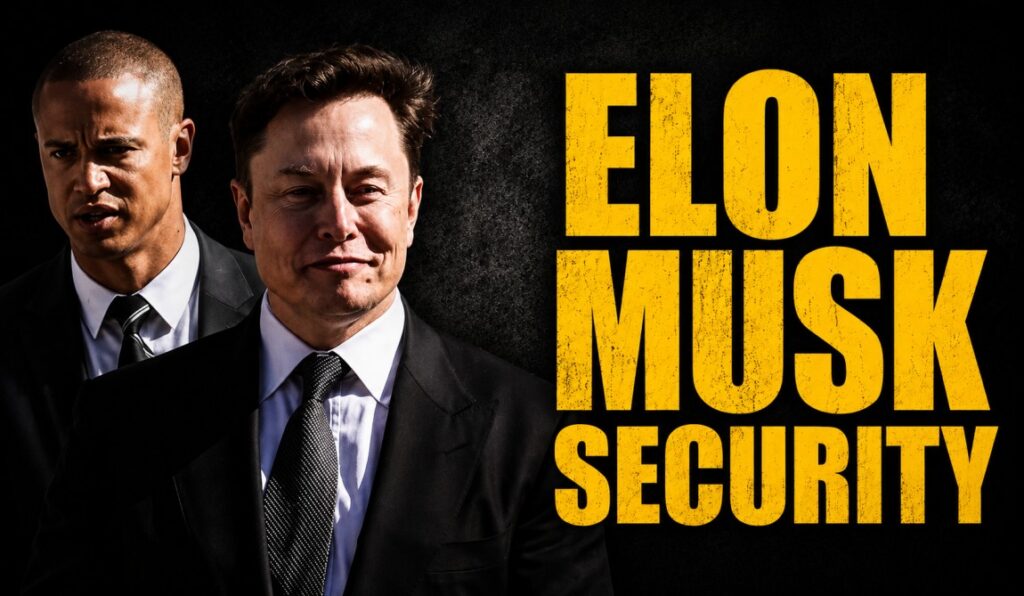
Elon Musk security has become one of the most searched topics in executive protection circles, and not just out of curiosity about billionaire bodyguards. Musk sits at the center of companies that touch space travel, energy, transportation, and communication infrastructure used around the world. When someone holds that much operational weight, personal safety stops being a private issue.
This article breaks down what’s actually known about how Musk is protected, based on public reporting, and why his situation looks nothing like standard celebrity security. It also explains why a disruption to his safety wouldn’t just affect him. It could ripple into markets, government operations, and public infrastructure that millions of people rely on every day.
Quick Answer: How Is Elon Musk Protected?
Elon Musk is guarded by a private security team reportedly known internally as “Voyager.” According to New York Times reporting, the detail includes up to 20 personnel, along with a dedicated medical professional, functioning similarly to a scaled-down version of a head-of-state protection unit. Tesla’s own financial filings have disclosed spending of roughly $2.4 million on his personal security in a single reported period.
Unlike many executives who rely on a handful of guards, Musk’s team reportedly clears rooms in advance, scouts escape routes, and stays close enough to accompany him even during routine daily activities. In 2025, some members of his detail were also deputized by the U.S. Marshals Service, giving them limited federal authority, a move that later drew scrutiny.
Inside Elon Musk’s Security Team
The “Voyager” Detail: Size and Structure
Musk’s security operation has grown substantially over the years. Earlier in his career, he was often seen with only one or two guards. That changed as his public profile, wealth, and political involvement expanded. Reporting indicates his current team blends full-time personnel who know his routines intimately with contracted specialists pulled from private security firms for specific skill sets.
The team’s internal code name, Voyager, reflects a level of operational discretion typically reserved for government protection details rather than private citizens.
What Musk’s Bodyguards Actually Do Day to Day
Contrary to the image of bodyguards simply standing nearby, Musk’s team reportedly performs a wider range of functions:
- Advance work, including checking locations before he arrives
- Route planning to avoid predictable or exposed paths
- Close protection during public appearances and travel
- Medical readiness, with a professional embedded in the detail
- Armed response capability, given the team’s firearms authorization
This kind of layered coverage is closer to what’s typically built around a sitting president or foreign dignitary than a corporate CEO.
How His Security Has Evolved Over Time
The shift from a two-person detail to a 20-person operation didn’t happen overnight. It tracks closely with Musk’s rising public visibility, his increasingly polarizing political statements, and his direct involvement in government-adjacent work. As his exposure grew, so did the scale and sophistication of the protection built around him.
The Deputization Controversy
Why Musk’s Guards Were Given Federal Authority
In February 2025, the U.S. Marshals Service approved a request, reportedly originating from the White House, to deputize members of Musk’s private security team. This gave them expanded legal standing, including the ability to carry weapons inside certain federal buildings while continuing to protect him.
The arrangement made sense on a practical level. Musk doesn’t have an official U.S. Secret Service detail, which meant his private guards previously had limited authority to operate in federal spaces, particularly in Washington, D.C.
The Training Gap That Raised Concerns
The deputization came with a catch. According to emails later released and reported by NBC News, some of Musk’s guards didn’t meet the Marshals Service’s usual experience and training requirements for that kind of authorization. The agency waived those standards to move forward anyway.
This detail matters for a simple reason: it shows the gap between how private security operates and how federal law enforcement is normally vetted. It also raises a legal wrinkle, since deputizing private guards can shift liability onto the federal agency if something goes wrong during an incident.
Why Elon Musk Isn’t a Typical Protection Case
Most executive protection programs are built around a fairly standard list of risks: stalking, harassment, targeted crime, and occasional extremist threats. Musk faces all of those. But his situation adds layers that most protectees never encounter.
He sits at the intersection of:
- Key-person risk, where his personal decisions directly move public markets
- Infrastructure dependency, since his companies support satellite communication and space launch capability
- Political entanglement, given his direct involvement in government initiatives
- Ideological polarization, which draws both fierce loyalty and open hostility
That combination puts him in a category that looks less like a typical billionaire and more like a head of state operating without formal state protection.
What Executive Protection at This Level Actually Involves
Physical and Travel Security
Close protection at Musk’s level covers far more than standing nearby during appearances. It includes secure ground transport, controlled arrival and departure timing, and constant awareness of surrounding crowds or vehicles.
Residential and Estate Protection
A protectee of this profile typically requires perimeter monitoring, access control at every entry point, and coordination between physical guards and technology systems that flag unusual activity before it becomes a direct threat.
Digital and Insider Threat Monitoring
Not every risk comes from a stranger. Executive protection teams working with high-profile figures also watch for insider risk, meaning employees, contractors, or household staff who could pose a threat through access or information leaks.
Intelligence and Advance Planning
Modern protection details don’t just react. They track online chatter, monitor for escalating threats tied to a person’s public statements, and adjust security posture before a situation ever reaches a physical location.
Why Security Failures Here Would Ripple Beyond Musk
Impact on Markets and Company Operations
Musk is closely tied to investor confidence in his companies. A serious security incident involving him could trigger sharp stock volatility, particularly for Tesla, where his personal brand is deeply woven into how the company is valued.
Impact on Government and Policy Ties
Given his role in government-adjacent initiatives and his companies’ work in space and satellite infrastructure, a disruption to his safety could force federal agencies to step in to maintain continuity in programs that depend on his companies.
Public and Cultural Reaction
Musk has become a lightning rod in public discourse, drawing intense reactions from supporters and critics alike. A major incident involving his security wouldn’t stay contained to news coverage. It would likely shape political and cultural conversations for months.
How Musk’s Security Compares to Other Public Figures
| Protection Level | Typical Team Size | Federal Authority | Scope of Coverage |
| Standard corporate executive | 1–4 guards | None | Office, home, occasional travel |
| Elon Musk (reported) | Up to 20 personnel | Partial, via 2025 deputization | Constant, including travel and public events |
| U.S. head of state | Dozens to hundreds (Secret Service) | Full federal authority | Continuous, government-funded, global reach |
Musk’s setup sits well above typical corporate protection but still falls short of full head-of-state coverage, since he lacks an official Secret Service detail and relies on privately funded, privately managed personnel instead.
The Case for Treating Executive Protection as Infrastructure
As figures like Musk take on roles that blend business leadership with public policy influence, the line between personal safety and public stability keeps getting blurrier. Protection at this scale isn’t about luxury or image. It’s closer to a form of operational infrastructure, similar to how organizations protect critical systems or leadership continuity in government and defense settings.
This shift explains why firms specializing in high-net-worth and executive protection have grown more sophisticated in recent years. The work now spans physical security, digital risk monitoring, legal coordination with agencies like the Marshals Service, and long-term threat assessment, rather than simply assigning guards to follow someone around.
FAQs
How many guards protect Elon Musk?
Reports indicate his detail includes up to 20 personnel, plus a dedicated medical professional.
What is Elon Musk’s security team called?
His detail reportedly goes by the internal code name “Voyager.”
Why were Musk’s bodyguards deputized by federal marshals?
Since he lacks an official Secret Service detail, deputization gave his private guards limited authority in federal buildings.
Does Elon Musk have Secret Service protection?
No, he relies entirely on privately funded and privately managed security rather than a formal government detail.
How much does Musk reportedly spend on personal security?
Tesla filings have disclosed spending of roughly $2.4 million in one reported period.
What sets Musk’s protection apart from typical executive security?
His role in critical infrastructure, government ties, and market influence puts him closer to head-of-state risk than corporate risk.
What happens if Musk’s security team fails to prevent an incident?
The fallout could extend beyond him personally, affecting markets, government programs, and public discourse.
Final Thoughts
Elon Musk security isn’t just a curiosity about billionaire bodyguards trailing a famous CEO. It reflects a genuine shift in how protection works when one person’s safety is tied to markets, infrastructure, and government operations that reach far beyond his own life. The reported size of his detail, the deputization controversy, and the sheer scope of what his teams have to monitor all point to the same conclusion: standard celebrity security models don’t apply here. Whether or not every detail about his protection is public, the pattern is clear. As individuals take on outsized influence over technology, industry, and public policy, their personal safety stops being a private matter and starts functioning as a form of shared risk management for everyone connected to their work.

I’m Rainlord, the creator of AgeBioHub. I focus only on writing age-based articles, answering simple questions like how old a person is.
Instead of covering multiple topics, I stay dedicated to this niche to keep my content clear, consistent, and useful. My goal is to provide quick and accurate age information in a way that’s easy for anyone to understand.